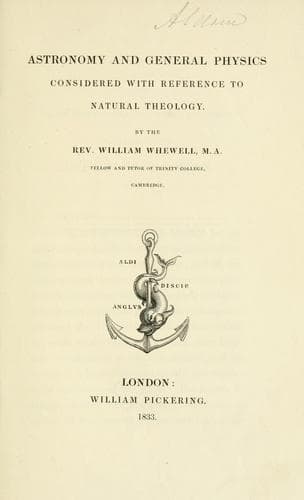
Astronomy and General Physics Considered with Reference to Natural TheologyWhewell, William
Religion
Astronomy and General Physics Considered with Reference to Natural Theology
Whewell, William
Astronomy; Cosmic physics; Natural theology
We conceive, therefore, that the laws by which God governs his
moral creatures, reside in his mind, invested with that kind of
generality, whatever it be, of which such laws are capable; but of
the character of such general laws, we know nothing more certainly
than this, that it must be altogether different from the character
of those laws which regulate the material world. The inevitable
necessity of such a total difference is suggested by the analogy of
all the knowledge which we possess and all the conceptions which we
can form. And, accordingly, no persons, except those whose minds
have been biassed by some peculiar habit or course of thought,
are likely to run into the confusion and perplexity which are
produced by assimilating too closely the government and direction
of voluntary agents to the production of trains of mechanical
and physical phenomena. In whatever manner voluntary and moral
agency depend upon the Supreme Being, it must be in some such way
that they still continue to bear the character of will, action,
and morality. And, though too exclusive an attention to material
phenomena may sometimes have made physical philosophers blind to
this manifest difference, it has been clearly seen and plainly
asserted by those who have taken the most comprehensive views of
the nature and tendency of science. “I believe,” says Bacon, in
his Confession of Faith, “that, at the first the soul of man was
not produced by heaven or earth, but was breathed immediately from
God; so that _the ways and proceedings of God with spirits are not
included in nature; that is in the laws of heaven and earth_; but
are reserved to the law of his secret will and grace; wherein God
worketh still, and resteth not from the work of redemption, as
he resteth from the work of creation; but continueth working to
the end of the world.” We may be permitted to observe here, that,
when Bacon has thus to speak of God’s dealings with his moral
creatures, he does not take his phraseology from those sciences
which can offer none but false and delusive analogies; but helps
out the inevitable scantiness of our human knowledge, by words
borrowed from a source more fitted to supply our imperfections.
Our natural speculations cannot carry us to the ideas of “grace”
and “redemption;” but in the wide blank which they leave, of all
that concerns our hopes of the Divine support and favour, the
inestimable knowledge which revelation, as we conceive, gives us,
finds ample room and appropriate place.
Public-domain text, read in full here on John Shaqi.
Reviews
Reviews
No reviews yet
Be the first to share your thoughts on this work.
Elsewhere in the archive
Join the Discussion
Join the discussion
Sign in to leave a comment or review.
Sign InorCreate an account