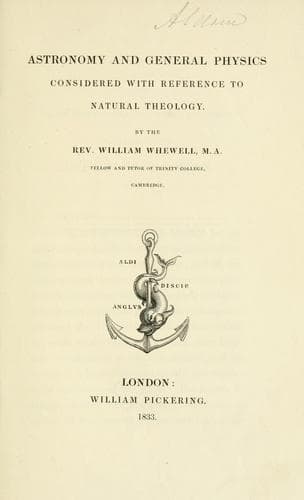
Astronomy and General Physics Considered with Reference to Natural TheologyWhewell, William
Religion
Astronomy and General Physics Considered with Reference to Natural Theology
Whewell, William
Astronomy; Cosmic physics; Natural theology
7. Yet even in the view of our moral constitution which natural
reason gives, we may trace laws that imply a personal relation to
our Creator. How can we avoid considering _that_ as a true view
of man’s being and place, without which, his best faculties are
never fully developed, his noblest energies never called out, his
highest point of perfection never reached? Without the thought of a
God over all, superintending our actions, approving our virtues,
transcending our highest conceptions of good, man would never rise
to those higher regions of moral excellence which we know him to
be capable of attaining. “To deny a God,” again says the great
philosopher, “destroys magnanimity and the raising of human nature;
for take an example of a dog, and mark what a generosity and
courage he will put on, when he finds himself maintained by a man;
who, to him, is instead of a God, or _melior natura_: which courage
is manifestly such, as that creature, without that confidence of
a better nature than his own, could never attain. So man, when he
resteth and assureth himself upon divine protection and favour,
gathereth a force and faith, which human nature could not obtain.
Therefore, as atheism is in all respects hateful, so in this, that
it depriveth human nature of the means to exalt itself above human
frailty.”[45]
Such a law, then, of reference to a Supremely Good Being, is
impressed upon our nature, as the condition and means of its
highest moral advancement. And strange indeed it would be if we
should suppose, that in a system where all besides indicates
purpose and design, this law should proceed from no such origin;
and no less inconceivable, that such a law, purposely impressed
upon man to purify and elevate his nature, should delude and
deceive him.
8. Nothing remains, therefore, but that the Creator, who, for
purposes that even we can see to be wise and good, has impressed
upon man this tendency to look to him for support, for advancement,
for such happiness as is reconcileable with holiness;--to believe
him to be the union of all perfection, the highest point of all
intellectual and moral excellence;--IS, in reality, such a guardian
and judge, such a good, and wise, and perfect Being, as we thus
irresistibly conceive him. It would indeed be extravagant to assert
that the imagination of the creature, itself the work of God, can
invent a higher point of goodness, of justice, of holiness, than
the Creator himself possesses: that the Eternal Mind, from whom our
notions of good and right are derived, is not himself directed by
the rules which these notions imply.
Public-domain text, read in full here on John Shaqi.
Reviews
Reviews
No reviews yet
Be the first to share your thoughts on this work.
Elsewhere in the archive
Join the Discussion
Join the discussion
Sign in to leave a comment or review.
Sign InorCreate an account