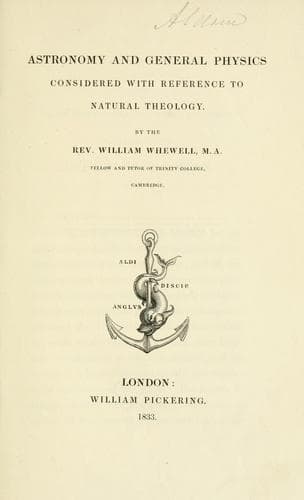
Astronomy and General Physics Considered with Reference to Natural TheologyWhewell, William
Religion
Astronomy and General Physics Considered with Reference to Natural Theology
Whewell, William
Astronomy; Cosmic physics; Natural theology
It is further remarkable that in the newly discovered planets, of
which the orbits are still more eccentric than that of Mercury, the
masses are still smaller, so that the same provision is established
in this case also. It does not appear that any mathematician has
even attempted to point out a necessary connexion between the mass
of a planet and the eccentricity of its orbit on any hypothesis.
May we not then consider this combination of small masses with
large eccentricities, so important to the purposes of the world, as
a mark of provident care in the Creator?
[19] The _eccentricity_ of a planet’s orbit is measured by taking
the proportion of the _difference_ of the greatest and least
distances from the sun, to the _sum_ of the same distances.
Mercury’s greatest and least distances are as two and three; his
eccentricity, therefore, is one-fifth.
[20] The stability of the axis of rotation about which the earth
revolves, has sometimes been adduced as an instance of preservative
care. The stability, however, would follow necessarily, if the
earth, or its superficial parts, were originally fluid; and
that they were so is an opinion widely received, both among
astronomers and geologists. The original fluidity of the earth
is probably a circumstance depending upon the general scheme of
creation; and cannot with propriety be considered with reference
to one particular result. We shall therefore omit any further
consideration of this argument.
[21] Airy on Encke’s Comet, p. 1, note.
[22] Principia, b. iii. prop. x.
[23] Paley.
[24] If the Laws of Motion are stated as _three_, which we conceive
to be the true view of the subject, the other two, as applied in
mechanical reasonings, are the following:
_Second Law._ When a force acts on a body in motion, it produces
the same effect as if the same force acted on a body at rest.
_Third Law._ When a force of the nature of pressure produces
motion, the velocity produced is proportional to the force, other
things beings equal.
[25] Though Friction is not concerned in any cosmical phenomena, we
have thought this the proper place to introduce the consideration
of it; since the contrast between the cases in which it does act,
and those in which it does not, is best illustrated by a comparison
of cosmical with terrestrial motions.
[26] Butler, Serm. 3.
[27] Müller, Infusoria, Preface.
[28] _Monas._ Müller. Cuvier.
[29] _Volvox._
[30] _Vibrio._ Müller. Cuvier.
[31] Dupuis. Origine des Cultes.
[32] Herschel on the Study of Nat. Phil. Art. 28.
[33] Amici me cunctantem atque etiam reluctantem, retraxerunt,
inter quos primus fuit Nicolaus Schonbergius, Cardinalis
Capuanus, in omni genere literatum celebris; proximus ille
vir mei amantissimus Tidemannus Gisius, episcopus Culmensis,
sacrarum ut est et omnium bonarum literarum studiosissimus.--_De
Revolutionibus. Præf. ad Paulum III._
[34] Lib. i. cx.
[35] Pensées, Art. viii. 1.
[36] Thomson’s Hist. of Chemistry, vol. i. 321.
Public-domain text, read in full here on John Shaqi.
Reviews
Reviews
No reviews yet
Be the first to share your thoughts on this work.
Elsewhere in the archive
Join the Discussion
Join the discussion
Sign in to leave a comment or review.
Sign InorCreate an account