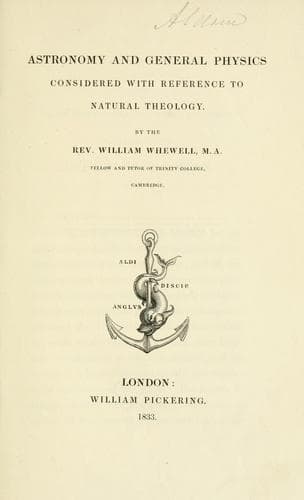
Astronomy and General Physics Considered with Reference to Natural TheologyWhewell, William
Religion
Astronomy and General Physics Considered with Reference to Natural Theology
Whewell, William
Astronomy; Cosmic physics; Natural theology
particular facts;--we find all full wisdom, and harmony, and
beauty: and all this wise selection of means, this harmonious
combination of laws, this beautiful symmetry of relations,
directed, with no exception which human investigation has yet
discovered, to the preservation, the diffusion, the well-being
of those living things, which, though of their nature we know
so little, we cannot doubt to be the worthiest objects of the
Creator’s care.
FINIS.
FOOTNOTES:
[1] Loudon, Encyclopædia of Gardening, 848.
[2] Dec. Phys. vol. ii. 478.
[3] Fleming, Zool. i. 400.
[4] Rapports du Physique et du Moral de l’Homme, II. 371.
[5] It will be observed that it is not here asserted that the
difference of native products depends on the difference of climate
_alone_.
[6] The resemblance consists in this; that we have a strip of
greater temperature accompanied by a strip of smaller temperature,
these strips arising from the diurnal and nocturnal impressions
respectively, and being in motion; as in the waves on a canal, we
have a moving strip of greater elevation accompanied by a strip
of smaller elevation. We do not here refer to any hypothetical
undulations in the fluid matter of heat.
[7] Loudon, 1219.
[8] Loudon, 1214.
[9] Manchester Memoirs, v. 357.
[10] Howard on the climate of London, vol. ii. pp. 216, 217.
[11] Daniell, Meteor. Ess. p. 56.
[12] Daniell. p. 129.
[13] Phil. Trans. 1821.
[14] Mr. Gough in Manch. Mem. vol. v.
[15] The reader who is acquainted with the two theories of light,
will perceive that though we have adopted the doctrine of the
ether, the greater part of the arguments adduced would be equally
forcible, if expressed in the language of the theory of emission.
[16] Or rather through the _focal centre_ of the eye, which is
always near the centre of the pupil.
[17] Laplace, Expos. du Syst. du Monde, p. 441.
[18] In this statement of Laplace, however, one remarkable
provision for the stability of the system is not noticed.
The planets Mercury and Mars, which have much the largest
eccentricities among the old planets, are those of which the
masses are much the smallest. The mass of Jupiter is more than two
thousand times that of either of these planets. If the orbit of
Jupiter were as eccentric as that of Mercury is, all the security
for the stability of the system, which analysis has yet pointed
out, would disappear. The earth and the smaller planets might in
that case change their approximately circular orbits into very long
ellipses, and thus might fall into the sun, and fly off into remote
space.
Public-domain text, read in full here on John Shaqi.
Reviews
Reviews
No reviews yet
Be the first to share your thoughts on this work.
Elsewhere in the archive
Join the Discussion
Join the discussion
Sign in to leave a comment or review.
Sign InorCreate an account