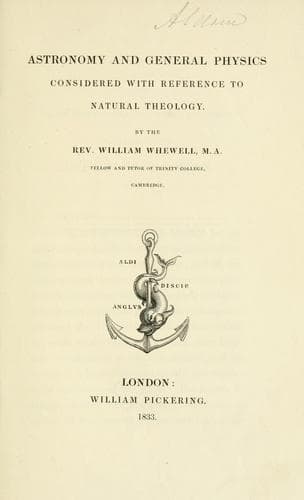
Astronomy and General Physics Considered with Reference to Natural Theology — John Shaqi
Astronomy and General Physics Considered with Reference to Natural TheologyWhewell, William
Religion
Astronomy and General Physics Considered with Reference to Natural Theology
Whewell, William
Astronomy; Cosmic physics; Natural theology
1. The first instance we shall take, is the force manifested by
the ascent of the sap in vegetables. It appears by a multitude
of indisputable experiments, (among the rest, those of Hales,
Mirbel, and Dutrochet,) that all plants imbibe moisture by their
roots, and _pump it up_, by some internal force, into every part
of their frame, distributing it into every leaf. It will be easily
conceived that this operation must require a very considerable
mechanical force; for the fluid must be sustained as if it were a
single column reaching to the top of the tree. The division into
minute parts and distribution through small vessels does not at all
diminish the total force requisite to raise it. If, for instance,
the tree be thirty-three feet high, the pressure must be fifteen
pounds upon every square inch in the section of the vessels of
the bottom in order merely to support the sap. And it is not only
supported, but propelled upwards with great force, so as to supply
the constant evaporation of the leaves. The pumping power of the
tree must, therefore, be very considerable.
That this power is great, has been confirmed by various curious
experiments, especially by those of Hales. He measured the force
with which the stems and branches of trees draw the fluid from
below, and push it upwards. He found, for instance, that a vine in
the _bleeding_ season could push up its sap in a glass tube to the
height of twenty-one feet above the stump of an amputated branch.
The force which produces this effect is part of the economy of the
vegetable world; and it is clear that the due operation of the
force depends upon its being rightly proportioned to the force of
gravity. The weight of the fluid must be counterbalanced, and an
excess of force must exist to produce the motion upwards. In the
common course of vegetable life, the rate of ascent of the sap is
regulated, on the one hand, by the upward pressure of the vegetable
power, and on the other, by the amount of the gravity of the fluid,
along with the other resistances, which are to be overcome. If,
therefore, we suppose gravity to increase, the rapidity of this
vegetable circulation will diminish, and the rate at which this
function proceeds, will not correspond either to the course of the
seasons, or the other physiological processes with which this has
to co-operate. We might easily conceive such an increase of gravity
as would stop the vital movements of the plant in a very short
time. In like manner, a diminution of the gravity of the vegetable
juices would accelerate the rising of the sap, and would, probably,
hurry and overload the leaves and other organs, so as to interfere
with their due operation. Some injurious change, at least, would
take place.
Public-domain text, read in full here on John Shaqi.
Reviews
Reviews
No reviews yet
Be the first to share your thoughts on this work.
Join the Discussion
Join the discussion
Sign in to leave a comment or review.
Sign InorCreate an account