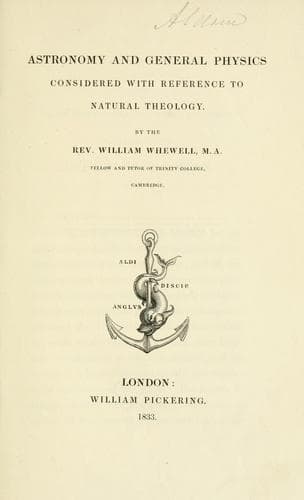
Astronomy and General Physics Considered with Reference to Natural TheologyWhewell, William
Religion
Astronomy and General Physics Considered with Reference to Natural Theology
Whewell, William
Astronomy; Cosmic physics; Natural theology
1. The succession and alternation, at any given place, of heat
and cold, rain and sunshine, wind and calm, and other atmospheric
changes, appears at first sight to be extremely irregular, and not
subject to any law. It is, however, easy to see, with a little
attention, that there is a certain degree of constancy in the
average weather and seasons of each place, though the particular
facts of which these generalities are made up seem to be out of the
reach of fixed laws. And when we apply any numerical measure to
these particular occurrences, and take the average of the numbers
thus observed, we generally find a remarkably close correspondence
in the numbers belonging to the whole, or to analogous portions of
successive years. This will be found to apply to the measures given
by the thermometer, the barometer, the hygrometer, the rain gauge,
and similar instruments. Thus it is found that very hot summers,
or very cold winters, raise or depress the mean annual temperature
very little above or below the general standard.
The heat may be expressed by degrees of the thermometer; the
temperature of the day is estimated by this measure taken at
a certain period of the day, which is found by experience to
correspond with the daily average; and the mean annual temperature
will then be the average of all the heights of the thermometer for
every day in the year.
The mean annual temperature of London, thus measured, is about
50 degrees 4-10ths. The frost of the year 1788 was so severe that
the Thames was passable on the ice; the mean temperature of that
year was 50 degrees 6-10ths, being within a small fraction a degree
of the standard. In 1796, when the greatest cold ever observed in
London occurred, the mean temperature of the year was 50 degrees
1-10th, which is likewise within a fraction of a degree of the
standard. In the severe winter of 1813-14, when the Thames, Tyne,
and other large rivers in England were completely frozen over, the
mean temperature of the two years was 49 degrees, being little more
than a degree below the standard. And in the year 1808, when the
summer was so hot that the temperature in London was as high as 93½
degrees, the mean heat of the year was 50½, which is about that of
the standard.
The same numerical indications of the constancy of climate at the
same place might be collected from the records of other instruments
of the kind above-mentioned.
We shall, hereafter, consider some of the very complex agencies by
which this steadiness is produced; and shall endeavour to point
out intentional adaptations to this object. But we may, in the
meantime, observe how this property of the atmospheric changes is
made subservient to a further object.
Public-domain text, read in full here on John Shaqi.
Reviews
Reviews
No reviews yet
Be the first to share your thoughts on this work.
Join the Discussion
Join the discussion
Sign in to leave a comment or review.
Sign InorCreate an account