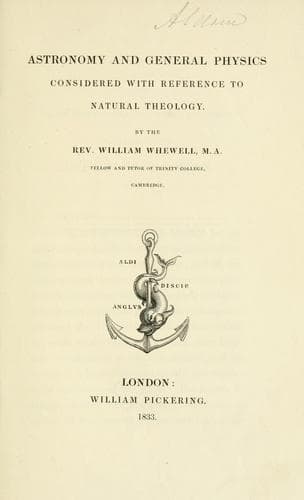
Astronomy and General Physics Considered with Reference to Natural Theology — John Shaqi
Astronomy and General Physics Considered with Reference to Natural TheologyWhewell, William
Religion
Astronomy and General Physics Considered with Reference to Natural Theology
Whewell, William
Astronomy; Cosmic physics; Natural theology
The intercourse of nations in the way of discovery, colonization,
commerce; the study of the natural history, manners, institutions
of foreign countries; lead to most numerous and important results.
Without dwelling upon this subject, it will probably be allowed
that such intercourse has a great influence upon the comforts, the
prosperity, the arts, the literature, the power, of the nations
which thus communicate. Now the variety of the productions of
different lands supplies both the stimulus to this intercourse, and
the instruments by which it produces its effects. The desire to
possess the objects or the knowledge which foreign countries alone
can supply, urges the trader, the traveller, the discoverer to
compass land and sea; and the progress of the arts and advantages
of civilization consists almost entirely in the cultivation, the
use, the improvement of that which has been received from other
countries.
This is the case to a much greater extent than might at first sight
be supposed. Where man is active as a cultivator, he scarcely ever
bestows much of his care on those vegetables which the land would
produce in a state of nature. He does not select some of the plants
of the soil and improve them by careful culture, but, for the most
part, he expels the native possessors of the land, and introduces
colonies of strangers.
Thus, to take the condition of our own part of the globe as an
example; scarcely one of the plants which occupy our fields and
gardens is indigenous to the country. The walnut and the peach
come to us from Persia; the apricot from Armenia: from Asia
Minor, and Syria, we have the cherry tree, the fig, the pear, the
pomegranate, the olive, the plum, and the mulberry. The vine which
is now cultivated is not a native of Europe; it is found wild on
the shores of the Caspian, in Armenia and Caramania. The most
useful species of plants, the _cereal_ vegetables, are certainly
strangers, though their birth place seems to be an impenetrable
secret. Some have fancied that barley is found wild on the banks
of the Semara, in Tartary, rye in Crete, wheat at Baschkiros, in
Asia; but this is held by the best botanists to be very doubtful.
The potatoe, which has been so widely diffused over the world in
modern times, and has added so much to the resources of life in
many countries, has been found equally difficult to trace back to
its wild condition.
Public-domain text, read in full here on John Shaqi.
Reviews
Reviews
No reviews yet
Be the first to share your thoughts on this work.
Join the Discussion
Join the discussion
Sign in to leave a comment or review.
Sign InorCreate an account