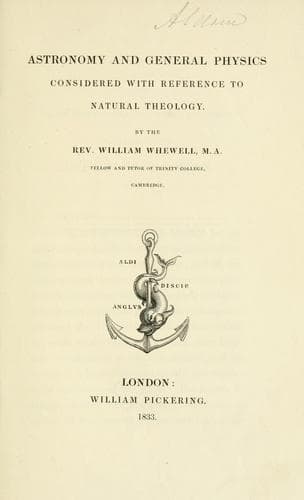
Astronomy and General Physics Considered with Reference to Natural TheologyWhewell, William
Religion
Astronomy and General Physics Considered with Reference to Natural Theology
Whewell, William
Astronomy; Cosmic physics; Natural theology
We can suppose the earth with no atmosphere except the vapour
which arises from its watery parts: and if we suppose also the
equatorial parts of the globe to be hot, and the polar parts cold,
we may easily see what would be the consequence. The waters at
the equator, and near the equator, would produce steam of greater
elasticity, rarity, and temperature, than that which occupies the
regions further _polewards_; and such steam, as it came in contact
with the colder vapour of a higher latitude, would be precipitated
into the form of water. Hence there would be a perpetual current
of steam from the equatorial parts towards each pole, which would
be condensed, would fall to the surface, and flow back to the
equator in the form of fluid. We should have a circulation which
might be regarded as a species of regulated distillation.[11] On
a globe so constituted, the sky of the equatorial zone would be
perpetually cloudless; but in all other latitudes we should have an
uninterrupted shroud of clouds, fogs, rains, and, near the poles, a
continual fall of snow. This would be balanced by a constant flow
of the currents of the ocean from each pole towards the equator. We
should have an excessive circulation of moisture, but no sunshine,
and probably only minute changes in the intensity and appearances
of one eternal drizzle or shower.
It is plain that this state of things would but ill answer the ends
of vegetable and animal life: so that even if the lungs of animals
and the leaves of plants were so constructed as to breathe steam
instead of air, an atmosphere of unmixed steam would deprive those
creatures of most of the other external conditions of their well
being.
The real state of things which we enjoy, the steam being mixed
in our breath and in our sky in a moderate quantity, gives rise
to results very different from those which have been described.
The machinery by which these results are produced is not a little
curious. It is in fact the machinery of the _weather_, and
therefore the reader will not be surprised to find it both complex
and apparently uncertain in its working. At the same time some
of the general principles which govern it seem now to be pretty
well made out, and they offer no small evidence of beneficent
arrangement.
Public-domain text, read in full here on John Shaqi.
Reviews
Reviews
No reviews yet
Be the first to share your thoughts on this work.
Elsewhere in the archive
Join the Discussion
Join the discussion
Sign in to leave a comment or review.
Sign InorCreate an account