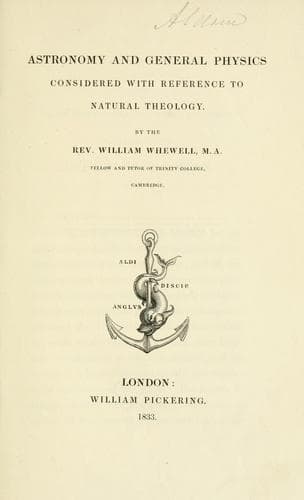
Astronomy and General Physics Considered with Reference to Natural TheologyWhewell, William
Religion
Astronomy and General Physics Considered with Reference to Natural Theology
Whewell, William
Astronomy; Cosmic physics; Natural theology
Besides our atmosphere of aqueous vapour, we have another and far
larger atmosphere of common air; a _permanently elastic_ fluid,
that is, one which is not condensed into a liquid form by pressure
or cold, such as it is exposed to in the order of natural events.
The pressure of the dry air is about twenty-nine and a half inches
of mercury; that of the watery vapour, perhaps, half an inch. Now
if we had the earth quite dry, and covered with an atmosphere of
dry air, we can trace in a great measure what would be the results,
supposing still the equatorial zone to be hot, and the temperature
of the surface to decrease perpetually as we advance into higher
latitudes. The air at the equator would be rarefied by the heat,
and would be perpetually displaced below by the denser portions
which belonged to cooler latitudes. We should have a current of
air from the equator to the poles in the higher regions of the
atmosphere, and at the surface a returning current setting towards
the equator to fill up the void so created. Such aerial currents,
combined with the rotatory motion of the earth, would produce
oblique winds; and we have in fact instances of winds so produced,
in the trade winds, which between the tropics blow constantly from
the quarters between east and north, and are, we know, balanced
by opposite currents in higher regions. The effect of a heated
surface of land would be the same as that of the heated zone of the
equator, and would attract to it a sea breeze during the day time,
a phenomenon, as we also know, of perpetual occurrence.
Now a mass of dry air of such a character as this, is by far the
dominant part of our atmosphere; and hence carries with it in its
motions the thinner and smaller eddies of aqueous vapour. The
latter fluid may be considered as permeating and moving in the
interstices of the former, as a spring of water flows through a
sand rock.[12] The lower current of air is, as has been said,
directed towards the equator, and hence it resists the motion of
the steam, the tendency of which is in the opposite direction; and
prevents or much retards that continual flow of hot vapour into
colder regions, by which a constant precipitation would take place
in the latter situations.
If, in this state of things, the flow of the current of air, which
blows from any colder place into a warmer region, be retarded or
stopped, the aqueous vapours will now be able to make their way
to the colder point, where they will be precipitated in clouds or
showers.
Thus, in the lower part of the atmosphere, there are tendencies
to a current of air in one direction, and a current of vapour in
the opposite; and these tendencies exist in the average weather
of places situated at a moderate distance from the equator. The
air tends from the colder to the warmer parts, the vapour from the
warmer to the colder.
Public-domain text, read in full here on John Shaqi.
Reviews
Reviews
No reviews yet
Be the first to share your thoughts on this work.
Elsewhere in the archive
Join the Discussion
Join the discussion
Sign in to leave a comment or review.
Sign InorCreate an account