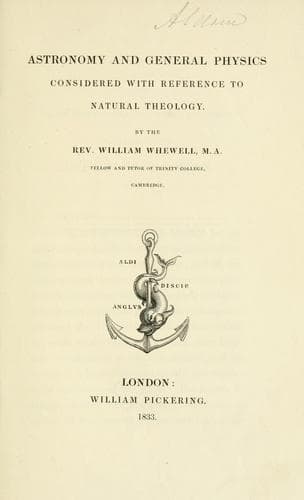
Astronomy and General Physics Considered with Reference to Natural TheologyWhewell, William
Religion
Astronomy and General Physics Considered with Reference to Natural Theology
Whewell, William
Astronomy; Cosmic physics; Natural theology
In both the simple atmospheres of which we have spoken, the one of
air and the one of steam, the property which we have mentioned must
exist. In each of them, both the temperature and the tension would
diminish in ascending. But they would diminish at very different
rates. The temperature, for instance, would decrease much more
rapidly for the same height in dry air than in steam. If we begin
with a temperature of 80 degrees at the surface, on ascending five
thousand feet the steam is still 76½ degrees, the air is only 64½
degrees; at ten thousand feet, the steam is 73 degrees, the air
48½ degrees; at fifteen thousand feet, steam is at 70 degrees,
air has fallen below the freezing point to 31½ degrees. Hence
these two atmospheres cannot exist together without modifying one
another: one must heat or cool the other, so that the coincident
parts may be of the same temperature. This accordingly does take
place, and this effect influences very greatly the constitution
of the atmosphere. For the most part, the steam is compelled to
accommodate itself to the temperature of the air, the latter being
of much the greater bulk. But if the upper parts of the aqueous
vapour be cooled down to the temperature of the air, they will not
by any means exert on the lower parts of the same vapour so great a
pressure as the gaseous form of these could bear. Hence, there will
be a deficiency of moisture in the lower part of the atmosphere,
and if water exist there, it will rise by evaporation, the surface
feeling an insufficient tension; and there will thus be a fresh
supply of vapour upwards. As, however, the upper regions already
contain as much as their temperature will support in the state of
gas, a precipitation will now take place, and the fluid thus formed
will descend till it arrives in a lower region, where the tension
and temperature are again adapted to its evaporation.
Thus, we can have no equilibrium in such an atmosphere, but a
perpetual circulation of vapour between its upper and lower parts.
The currents of air which move about in different directions, at
different altitudes, will be differently charged with moisture, and
as they touch and mingle, lines of cloud are formed, which grow and
join, and are spread out in floors, or rolled together in piles.
These, again, by an additional accession of humidity, are formed
into drops, and descend in showers into the lower regions, and if
not evaporated in their fall, reach the surface of the earth.
Public-domain text, read in full here on John Shaqi.
Reviews
Reviews
No reviews yet
Be the first to share your thoughts on this work.
Elsewhere in the archive
Join the Discussion
Join the discussion
Sign in to leave a comment or review.
Sign InorCreate an account