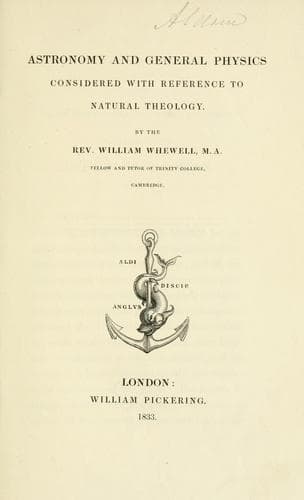
Astronomy and General Physics Considered with Reference to Natural TheologyWhewell, William
Religion
Astronomy and General Physics Considered with Reference to Natural Theology
Whewell, William
Astronomy; Cosmic physics; Natural theology
The varying occurrences thus produced, tend to multiply and extend
their own variety. The ascending streams of vapour carry with them
that _latent heat_ belonging to their gaseous state, which, when
they are condensed, they give out as sensible heat. They thus
raise the temperature of the upper regions of air, and occasion
changes in the pressure and motion of its currents. The clouds,
again, by shading the surface of the earth from the sun, diminish
the evaporation by which their own substance is supplied, and
the heating effects by which currents are caused. Even the mere
mechanical effects of the currents of fluid on the distribution of
its own pressure, and the dynamical conditions of its motion, are
in a high degree abstruse in their principles and complex in their
results. It need not be wondered, therefore, if the study of this
subject is very difficult and entangled, and our knowledge, after
all, very imperfect.
In the middle of all this apparent confusion, however, we can
see much that we can understand. And, among other things, we may
notice some of the consequences of the difference of the laws
of temperature followed by steam and by air in going upwards.
One important result is that the atmosphere is much drier, near
the surface, than it would have been if the laws of density and
temperature had been the same for both gases. If this had been so,
the air would always have been _saturated_ with vapour. It would
have contained as much as the existing temperature could support,
and the slightest cooling of any object would have covered it with
a watery film like dew. As it is, the air contains much less than
its full quantity of vapour: we may often cool an object ten,
twenty, or thirty degrees without obtaining a deposition of water
upon it, or reaching the _dew-point_, as it is called. To have had
such a _dripping_ state of the atmosphere as the former arrangement
would have produced, would have been inconvenient, and so far
as we can judge, unsuited to vegetables as well as animals. No
evaporation from the surface of either could have taken place under
such conditions.
The sizes and forms of clouds appear to depend on the same
circumstance, of the air not being saturated with moisture. And it
is seemingly much better that clouds should be comparatively small
and well defined, as they are, than that they should fill vast
depths of the atmosphere with a thin mist, which would have been
the consequence of the imaginary condition of things just mentioned.
Public-domain text, read in full here on John Shaqi.
Reviews
Reviews
No reviews yet
Be the first to share your thoughts on this work.
Elsewhere in the archive
Join the Discussion
Join the discussion
Sign in to leave a comment or review.
Sign InorCreate an account