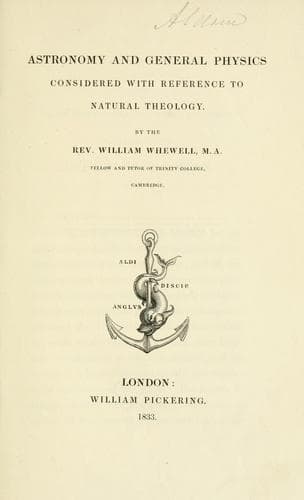
Astronomy and General Physics Considered with Reference to Natural TheologyWhewell, William
Religion
Astronomy and General Physics Considered with Reference to Natural Theology
Whewell, William
Astronomy; Cosmic physics; Natural theology
We are so constituted, however, that these crises impress almost
every one with a feeling of awe. The deep lowering gloom of the
thunder-cloud, the overwhelming burst of the explosion, the flash
from which the steadiest eye shrinks, and the irresistible arrow of
the lightning which no earthly substance can withstand, speak of
something fearful, even independently of the personal danger which
they may whisper. They convey, far more than any other appearance
does, the idea of a superior and mighty power, manifesting
displeasure and threatening punishment. Yet we find that this is
not the language which they speak to the physical inquirer: he sees
these formidable symptoms only as the means or the consequences
of good. What office the thunderbolt and the whirlwind may have
in the _moral_ world, we cannot here discuss: but certainly _he_
must speculate as far beyond the limits of philosophy as of piety,
who pretends to have learnt that there their work has more of evil
than of good. In the _natural_ world, these apparently destructive
agents are, like all the other movements and appearances of the
atmosphere, parts of a great scheme, of which every discoverable
purpose is marked with beneficence as well as wisdom.
CHAPTER XII.
_The Laws of Magnetism._
Magnetism has no very obvious or apparently extensive office in
the mechanism of the atmosphere and the earth: but the mention of
it may be introduced, because its ascertained relations to the
other powers which exist in the system are well suited to show us
the connexion subsisting throughout the universe, and to check the
suspicion, if any such should arise, that any law of nature is
without its use. The parts of creation when these uses are most
obscure, are precisely those parts when the laws themselves are
least known.
When indeed we consider the vast service of which magnetism is to
man, by supplying him with that invaluable instrument the mariners’
compass, many persons will require no further evidence of this
property being introduced into the frame of things with a worthy
purpose. As however, we have hitherto excluded _use in the arts_
from our line of argument, we shall not here make an exception in
favour of navigation, and what we shall observe belongs to another
view of the subject.
Public-domain text, read in full here on John Shaqi.
Reviews
Reviews
No reviews yet
Be the first to share your thoughts on this work.
Elsewhere in the archive
Join the Discussion
Join the discussion
Sign in to leave a comment or review.
Sign InorCreate an account