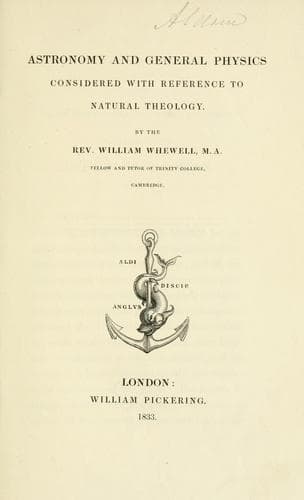
Astronomy and General Physics Considered with Reference to Natural TheologyWhewell, William
Religion
Astronomy and General Physics Considered with Reference to Natural Theology
Whewell, William
Astronomy; Cosmic physics; Natural theology
Magnetism has been discovered in modern times to have so close
a connexion with galvanism, that they may be said to be almost
different aspects of the same agent. All the phenomena which we can
produce with magnets, we can imitate with coils of galvanic wire.
That galvanism exists in the earth, we need no proof. Electricity,
which appears to be only galvanism in equilibrium, is there in
abundance; and recently, Mr. Fox[13] has shown by experiment that
metalliferous veins, as they lie in the earth, exercise a galvanic
influence on each other. Something of this kind might have been
anticipated; for masses of metal in contact, if they differ in
temperature or other circumstances, are known to produce a galvanic
current. Hence we have undoubtedly streams of galvanic influence
moving along in the earth. Whether or not such causes as these
produce the directive power of the magnetic needle, we cannot here
pretend to decide; they can hardly fail to affect it. The Aurora
Borealis too, probably an electrical phenomenon, is said, under
particular circumstances, to agitate the magnetic needle. It is
not surprising, therefore, that, if electricity have an important
office in the atmosphere, magnetism should exist in the earth. It
seems likely, that the magnetic properties of the earth may be
collateral results of the existence of the same cause by which
electrical agency operates; an agency which, as we have already
seen, has important offices in the processes of vegetable life. And
thus magnetism belongs to the same system of beneficial contrivance
to which electricity has been already traced.
We see, however, on this subject very dimly and a very small way.
It can hardly be doubted that magnetism has other functions than
those we have noticed.
CHAPTER XIII.
_The Properties of Light with regard to Vegetation._
The illuminating power of light will come under our consideration
hereafter. Its agency, with regard to organic life, is too
important not to be noticed, though this must be done briefly.
Light appears to be as necessary to the health of plants as air
of moisture. A plant may, indeed, grow without it, but it does
not appear that a species could be so continued. Under such a
privation, the parts which are usually green, assume a white
colour, as is the case with vegetables grown in a cellar, or
protected by a covering for the sake of producing this very effect;
thus, celery, is in this manner blanched, or _etiolated_.
Public-domain text, read in full here on John Shaqi.
Reviews
Reviews
No reviews yet
Be the first to share your thoughts on this work.
Elsewhere in the archive
Join the Discussion
Join the discussion
Sign in to leave a comment or review.
Sign InorCreate an account