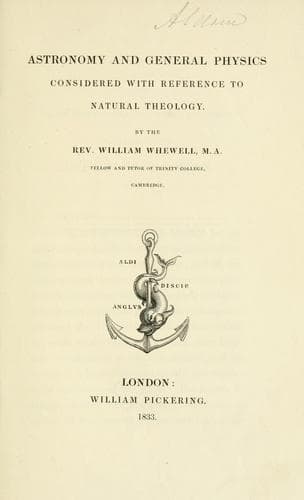
Astronomy and General Physics Considered with Reference to Natural TheologyWhewell, William
Religion
Astronomy and General Physics Considered with Reference to Natural Theology
Whewell, William
Astronomy; Cosmic physics; Natural theology
These differences are produced by the different _rapidity_ of
vibration of the particles of air. The gravest sound has about
eighty vibrations in a second, the most acute about one thousand.
Between these limits each sound has a musical character, and from
the different relations of the number of vibrations in a second
arise all the differences of musical intervals, concords and
discords.
4. The _quality_ of sounds is another of their differences. This is
the name given to the difference of notes of the same pitch, that
is the same note as to acute and grave, when produced by different
instruments. If a flute and a violin be in unison, the notes are
still quite different sounds. It is this kind of difference which
distinguishes the voice of one man from that of another: and it is
manifestly therefore one of great consequence; since it connects
the voice with the particular person, and is almost necessary in
order that language may be a medium of intercourse between men.
5. The _articulate_ character of sounds is for us one of the most
important arrangements which exist in the world; for it is by this
that they become the interpreters of thought, will and feeling, the
means by which a person can convey his wants, his instructions,
his promises, his kindness, to others; by which one man can
regulate the actions and influence the convictions and judgments
of another. It is in virtue of the possibility of shaping air into
words, that the imperceptible vibrations which a man produces in
the atmosphere, become some of his most important actions; the
foundations of the highest moral and social relations; and the
condition and instrument of all the advancement and improvement of
which he is susceptible.
It appears that the differences of articulate sound arise from
the different form of the cavity through which the sound is made
to proceed immediately _after_ being produced. In the human voice
the sound is produced in the larynx, and modified by the cavity of
the mouth, and the various organs which surround this cavity. The
laws by which articulate sounds are thus produced have not yet been
fully developed, but appear to be in the progress of being so.
The properties of sounds which have been mentioned, differences
of loudness, of pitch, of quality, and articulation, appear to be
all requisite in order that sound shall answer its purposes in
the economy of animal and of human life. And how was the air made
capable of conveying these four differences, at the same time that
the organs were made capable of producing them? Surely by a most
refined and skilful adaptation, applied with a most comprehensive
design.
Public-domain text, read in full here on John Shaqi.
Reviews
Reviews
No reviews yet
Be the first to share your thoughts on this work.
Elsewhere in the archive
Join the Discussion
Join the discussion
Sign in to leave a comment or review.
Sign InorCreate an account