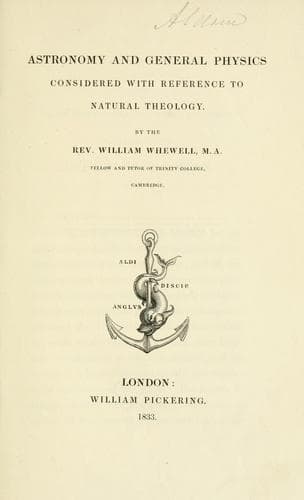
Astronomy and General Physics Considered with Reference to Natural TheologyWhewell, William
Religion
Astronomy and General Physics Considered with Reference to Natural Theology
Whewell, William
Astronomy; Cosmic physics; Natural theology
6. Again; is it by chance that the air and the _ear_ exist
together? Did the air produce the organization of the ear? or the
ear, independently organized, anticipate the constitution of the
atmosphere? Or is not the only intelligible account of the matter,
this, that one was made for the other: that there is a mutual
adaptation produced by an Intelligence which was acquainted with
the properties of both; which adjusted them to each other as we
find them adjusted, in order that birds might communicate by song,
that men might speak and hear, and that language might play its
extraordinary part in its operation upon men’s thoughts, actions,
institutions, and fortunes?
The vibrations of an elastic fluid like the air, and their
properties, follow from the laws of motion; and whether or not
these laws of the motion of fluids might in reality have been other
than they are, they appear to us inseparably connected with the
existence of matter, and as much a thing of necessity as we can
conceive any thing in the universe to be. The propagation of such
vibrations, therefore, and their properties, we may at present
allow to be a necessary part of the constitution of the atmosphere.
But what is it that makes these vibrations become sound? How is it
that they produce such an effect on our senses, and, through those,
on our minds? The vibrations of the air seem to be of themselves
no more fitted to produce sound, than to produce smell. We know
that such vibrations do not universally produce sound, but only
between certain limits. When the vibrations are fewer than eighty
in a second, they are perceived as separate throbs, and not as a
continued sound; and there is a certain limit of rapidity, beyond
which the vibrations become inaudible. This limit is different to
different ears, and we are thus assured by one person’s ear that
there are vibrations, though to that of another they do not produce
sound. How was the human ear adapted so that its perception of
vibrations as sounds should fall within these limits?--the very
limits within which the vibrations fall, which it most concerns
us to perceive: those of the human voice for instance? How nicely
are the organs adjusted with regard to the most minute mechanical
motions of the elements?
CHAPTER XV.
_The Atmosphere._
We have considered in succession a number of the properties and
operations of the atmosphere, and have found them separately very
curious. But an additional interest belongs to the subject when we
consider them as combined. The atmosphere under this point of view
must appear a contrivance of the most extraordinary kind. To answer
any of its purposes, to carry on any of its processes, separately,
requires peculiar arrangements and adjustments; to answer, all at
once, purposes so varied, to combine without confusion so many
different trains, implies powers and attributes which can hardly
fail to excite in a high degree our admiration and reverence.
Public-domain text, read in full here on John Shaqi.
Reviews
Reviews
No reviews yet
Be the first to share your thoughts on this work.
Elsewhere in the archive
Join the Discussion
Join the discussion
Sign in to leave a comment or review.
Sign InorCreate an account