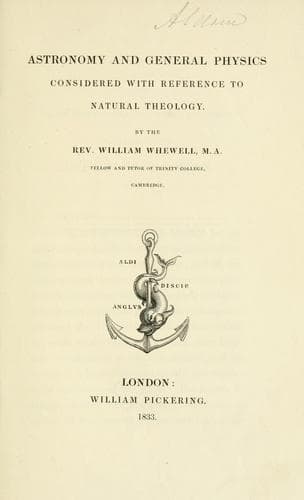
Astronomy and General Physics Considered with Reference to Natural TheologyWhewell, William
Religion
Astronomy and General Physics Considered with Reference to Natural Theology
Whewell, William
Astronomy; Cosmic physics; Natural theology
11. The Quantity of Latent Heat absorbed in Thawing.
12. The Quantity of Latent Heat absorbed in Evaporation.
13. The Law and Rate of Evaporation with regard to Heat.
14. The Law and Rate of the Expansion of Air by Heat.
15. The Quantity of Heat absorbed in the Expansion of Air.
16. The Law and Rate of the Passage of Aqueous Vapour through Air.
17. The Laws of Electricity; its relations to Air and Moisture.
18. The Fluidity, Density, and Elasticity of the Air, by means of
which its vibrations produce Sound.
19. The Fluidity, Density, and Elasticity of the Ether, by means
of which its vibrations produce Light.
2. These are the _data_, the _elements_, as astronomers call
the quantities which determine a planet’s orbit, on which the
mere _inorganic_ part of the universe is constructed. To these,
the constitution of the organic world is adapted in innumerable
points, by laws of which we can trace the results, though we cannot
analyze their machinery. Thus, the vital functions of vegetables
have periods which correspond to the length of the year, and of
the day; their vital powers have forces which correspond to the
force of gravity; the sentient faculties of man are such that
the vibrations of air (within certain limits,) are perceived as
sound, those of ether, as light. And while we are enumerating these
correspondencies, we perceive that there are thousands of others,
and that we can only select a very small number of those where
the relation happens to be most clearly made out or most easily
explained.
Public-domain text, read in full here on John Shaqi.
Reviews
Reviews
No reviews yet
Be the first to share your thoughts on this work.
Elsewhere in the archive
Join the Discussion
Join the discussion
Sign in to leave a comment or review.
Sign InorCreate an account