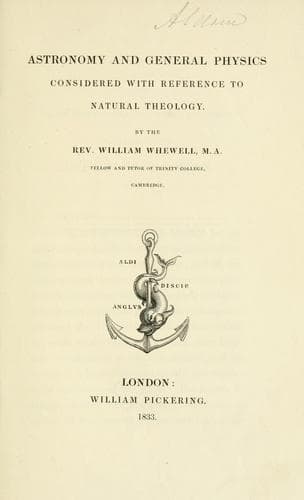
Astronomy and General Physics Considered with Reference to Natural TheologyWhewell, William
Religion
Astronomy and General Physics Considered with Reference to Natural Theology
Whewell, William
Astronomy; Cosmic physics; Natural theology
Now, in the list of the mathematical _elements_ of the universe
which has just been given, why have we such laws and such
quantities as there occur, and no other? For the most part, the
data there enumerated are independent of each other, and might be
altered separately, so far as the mechanical conditions of the case
are concerned. Some of these data probably depend on each other.
Thus the latent heat of aqueous vapour is perhaps connected with
the difference of the rate of expansion of water and of steam. But
all natural philosophers will, probably, agree, that there must be,
in this list, a great number of things entirely without any mutual
dependence, as the year and the day, the expansion of air and the
expansion of steam. There are, therefore, it appears, a number
of things which, in the structure of the world, might have been
otherwise, and which are what they are in consequence of choice or
of chance. We have already seen, in many of the cases separately,
how unlike chance every thing looks:--that substances, which might
have existed any how, so far as they themselves are concerned,
exist exactly in such a manner and measure as they should, to
secure the welfare of other things:--that the laws are tempered
and fitted together in the only way in which the world could have
gone on, according to all that we can conceive of it. This must,
therefore, be the work of choice; and if so, it cannot be doubted,
of a most wise and benevolent Chooser.
3. The appearance of choice is still further illustrated by the
variety as well as the number of the laws selected. The laws are
unlike one another. Steam certainly expands at a very different
_rate_ from air by the application of heat, probably according to a
different _law_: water expands in freezing, but mercury contracts:
heat travels in a manner quite different through solids and fluids.
Every separate substance has its own density, gravity, cohesion,
elasticity, its relations to heat, to electricity, to magnetism;
besides all its chemical affinities, which form an endless throng
of laws, connecting every one substance in creation with every
other, and different for each pair anyhow taken. Nothing can
look less like a world formed of atoms operating upon each other
according to some universal and inevitable laws, than this does: if
such a system of things be conceivable, it cannot be our system.
We have, it may be, fifty simple substances in the world; each of
which is invested with properties, both of chemical and mechanical
action, altogether different from those of any other substance.
Every portion, however minute, of any of these, possesses all
the properties of the substance. Of each of these substances
there is a certain unalterable quantity in the universe; when
combined, their compounds exhibit new chemical affinities, new
mechanical laws. Who gave these different laws to the different
substances? who proportioned the quantity of each? But suppose
this done.
Public-domain text, read in full here on John Shaqi.
Reviews
Reviews
No reviews yet
Be the first to share your thoughts on this work.
Elsewhere in the archive
Join the Discussion
Join the discussion
Sign in to leave a comment or review.
Sign InorCreate an account