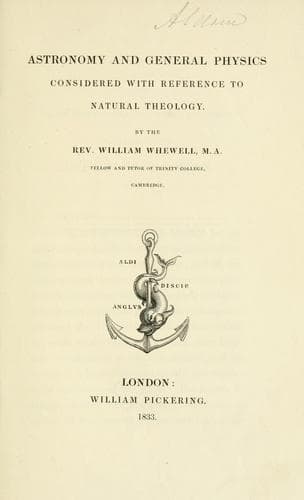
Astronomy and General Physics Considered with Reference to Natural TheologyWhewell, William
Religion
Astronomy and General Physics Considered with Reference to Natural Theology
Whewell, William
Astronomy; Cosmic physics; Natural theology
In the cosmical considerations which we have to offer, we shall
suppose the general truths concerning the structure of the solar
system and of the universe, which have been established by
astronomers and mathematicians, to be known to the reader. It is
not necessary to go into much detail on this subject. The five
planets known to the ancients, Mercury, Venus, Mars, Jupiter,
Saturn, revolve round the sun, at different distances, in orbits
nearly circular, and nearly in one plane. Between Venus and Mars,
our Earth, herself one of the planets, revolves in like manner.
Beyond Saturn, Uranus has been discovered describing an orbit of
the same kind; and between Mars and Jupiter, four smaller bodies
perform their revolutions in orbits somewhat less regular than
the rest. These planets are all nearly globular, and all revolve
upon their axis. Some of them are accompanied by satellites, or
attendant bodies which revolve about them; and these bodies also
have their orbits nearly circular, and nearly in the same plane as
the others. Saturn’s ring is a solitary example, so far as we know,
of such an appendage to a planet.
These circular motions of the planets round the sun, and of the
satellites round their primary planets, are all kept going by the
_attraction_ of the respective central bodies, which restrains the
corresponding revolving bodies from flying off. It is perhaps not
very easy to make this operation clear to common apprehension. We
cannot illustrate it by a comparison with any machine of human
contrivance and fabrication: in such machines every thing goes
on by contact and impulse: pressure, and force of all kinds, is
exercised and transferred from one part to another, by means of a
material connexion; by rods, ropes, fluids, gases. In the machinery
of the universe there is, so far as we know, no material connexion
between the parts which act on each other. In the solar system no
part touches or drives another: all the bodies affect each other
_at a distance_, as the magnet affects the needle. The production
and regulation of such effects, if attempted by our mechanicians,
would require great skill and nicety of adjustment; but our artists
have not executed any examples of this sort of machinery, by
reference to which we can illustrate the arrangements of the solar
system.
Public-domain text, read in full here on John Shaqi.
Reviews
Reviews
No reviews yet
Be the first to share your thoughts on this work.
Elsewhere in the archive
Join the Discussion
Join the discussion
Sign in to leave a comment or review.
Sign InorCreate an account