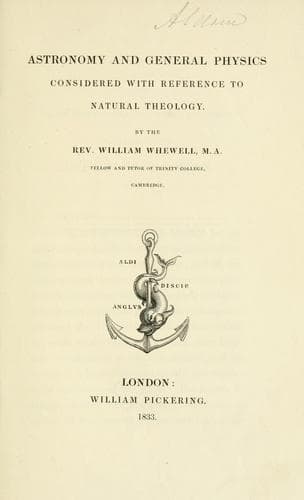
Astronomy and General Physics Considered with Reference to Natural TheologyWhewell, William
Religion
Astronomy and General Physics Considered with Reference to Natural Theology
Whewell, William
Astronomy; Cosmic physics; Natural theology
If each planet were to revolve round the sun without being affected
by the other planets, there would be a certain degree of regularity
in its motion; and this regularity would continue for ever. But it
appears, by the discovery of the law of universal gravitation,
that the planets do not execute their movements in this insulated
and independent manner. Each of them is acted on by the attraction
of all the rest. The Earth is constantly drawn by Venus, by Mars,
by Jupiter, bodies of various magnitudes, perpetually changing
their distances and positions with regard to the earth; the Earth
in return is perpetually drawing these bodies. What, in the course
of time, will be the result of this mutual attraction?
All the planets are very small compared with the sun, and therefore
the derangement which they produce in the motion of one of their
number will be very small in the course of one revolution. But this
gives us no security that the derangement may not become very large
in the course of many revolutions. The cause acts perpetually,
and it has the whole extent of time to work in. Is it not easily
conceivable then that in the lapse of ages the derangements of
the motions of the planets may accumulate, the orbits may change
their form, their mutual distances may be much increased or much
diminished? Is it not possible that these changes may go on without
limit, and end in the complete subversion and ruin of the system?
If, for instance, the result of this mutual gravitation should be
to increase considerably the eccentricity of the earth’s orbit,
that is to make it a longer and longer oval; or to make the moon
approach perpetually nearer and nearer the earth every revolution;
it is easy to see that in the one case our year would change its
character, as we have noticed in the last section; in the other,
our satellite might finally fall to the earth, which must of
course bring about a dreadful catastrophe. If the positions of
the planetary orbits, with respect to that of the earth, were to
change much, the planets might sometimes come very near us, and
thus exaggerate the effects of their attraction beyond calculable
limits. Under such circumstances, we might have “years of unequal
length, and seasons of capricious temperature, planets and moons of
portentous size and aspect, glaring and disappearing at uncertain
intervals;” tides like deluges, sweeping over whole continents;
and, perhaps, the collision of two of the planets, and the
consequent destruction of all organization on both of them.
Public-domain text, read in full here on John Shaqi.
Reviews
Reviews
No reviews yet
Be the first to share your thoughts on this work.
Elsewhere in the archive
Join the Discussion
Join the discussion
Sign in to leave a comment or review.
Sign InorCreate an account