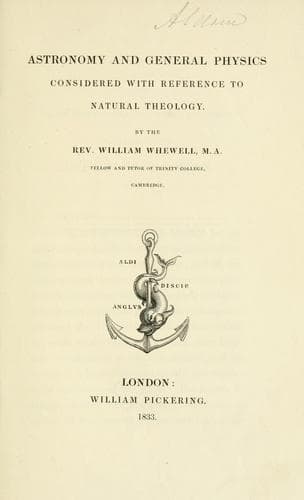
Astronomy and General Physics Considered with Reference to Natural TheologyWhewell, William
Religion
Astronomy and General Physics Considered with Reference to Natural Theology
Whewell, William
Astronomy; Cosmic physics; Natural theology
Nor is it, on a common examination of the history of the solar
system, at all clear that there is no tendency to indefinite
derangement. The fact really is, that changes are taking place
in the motions of the heavenly bodies, which have gone on
progressively from the first dawn of science. The eccentricity
of the earth’s orbit has been diminishing from the earliest
observations to our times. The moon has been moving quicker and
quicker from the time of the first recorded eclipses, and is now
in advance, by about four times her own breadth, of what her place
would have been if it had not been affected by this acceleration.
The obliquity of the ecliptic also is in a state of diminution, and
is now about two-fifths of a degree less than it was in the time
of Aristotle. Will these changes go on without limit or reaction?
If so, we tend by natural causes to a termination of the present
system of things: If not, by what adjustment or combination are we
secured from such a tendency? Is the system _stable_, and if so,
what is the condition on which its stability depends?
To answer these questions is far from easy. The mechanical problem
which they involve is no less than this;--Having given the
directions and velocities with which about thirty bodies are moving
at one time, to find their places and motions after any number of
ages; each of the bodies, all the while, attracting all the others,
and being attracted by them all.
It may readily be imagined that this is a problem of extreme
complexity, when it is considered that every new _configuration_
or arrangement of the bodies will give rise to a new amount of
action on each; and every new action to a new configuration.
Accordingly, the mathematical investigation of such questions as
the above was too difficult to be attempted in the earlier periods
of the progress of Physical Astronomy. Newton did not undertake to
demonstrate either the stability or the instability of the system.
The decision of this point required a great number of preparatory
steps and simplifications, and such progress in the invention
and improvement of mathematical methods, as occupied the best
mathematicians of Europe for the greater part of last century.
But, towards the end of that time, it was shown by Lagrange and
Laplace that the arrangements of the solar system are stable: that
in the long run, the orbits and motions remain unchanged; and that
the changes in the orbits, which take place in shorter periods,
never transgress certain very moderate limits. Each orbit undergoes
deviations on this side and on that of its average state; but these
deviations are never very great, and it finally recovers from them,
so that the average is preserved. The planets produce perpetual
perturbations in each other’s motions, but these perturbations
are not indefinitely progressive, they are periodical: they reach
a _maximum_ value and then diminish. The periods which this
restoration requires are, for the most part, enormous; not less
Public-domain text, read in full here on John Shaqi.
Reviews
Reviews
No reviews yet
Be the first to share your thoughts on this work.
Elsewhere in the archive
Join the Discussion
Join the discussion
Sign in to leave a comment or review.
Sign InorCreate an account