If the writer succeeds in arousing the child's interest in the stars
so that he may look forth with intelligence at the heavens and
greet the stars as friends and at the same time grasps some of the
simplest and most fundamental of astronomical truths such as the
distinction between stars and planets, the motions of the heavenly
bodies and their relative distances from us and the place of our own
planet-world in the universe, this book will have served its purpose.
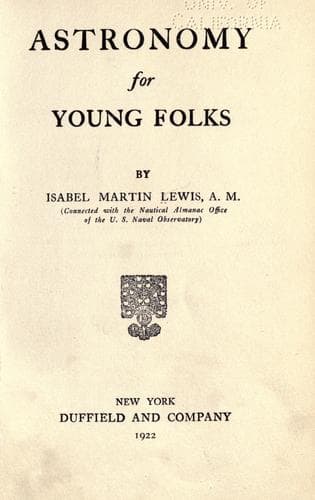
ASTRONOMY
FOR YOUNG FOLKS
"The heavens declare the glory of God, and the firmament showeth
His handiwork."
Psalm XIX.
I
THE CONSTELLATIONS
"Canst thou bind the sweet influences of the Pleiades
Or loose the bands of Orion?
Canst thou bring forth Mazzaroth in his season
Or canst thou guide Arcturus with his sons?"
--BOOK OF JOB.
Who would not like to know the stars and constellations by their
names and in their seasons as we know the birds and the trees and
the flowers, to recognize at their return, year by year, Sirius and
Spica, Arcturus and Antares, Vega and Altair, to know when Ursa Major
swings high overhead and Orion sinks to rest beneath the western
horizon, when Leo comes into view in the east or the Northern Crown
lies overhead?
Often we deprive ourselves of the pleasure of making friends with the
stars and shut our eyes to the glories of the heavens above because
we do not realize how simple a matter it is to become acquainted with
the various groups of stars as they cross our meridian, one by one,
day after day and month after month in the same orderly sequence.
When the robin returns once more to nest in the same orchard in the
spring time, Leo and Virgo may be seen rising above the eastern
horizon in the early evening hours. When the first snow flies in
the late fall and the birds have all gone southward the belt of
Orion appears in the east and Cygnus dips low in the west. When we
once come to know brilliant blue-white Vega, ruddy Arcturus, golden
Capella and sparkling Sirius we watch for them to return each in its
proper season and greet them as old friends.
In the following pages we give for each month the constellations
or star-groups that are nearest to our meridian, that is, that lie
either due north or due south or exactly overhead in the early part
of the month and the early part of the evening.
We do not need to start our study of the constellations in January.
We may start at any month in the year and we will find the
constellations given for that month on or near the meridian at the
time indicated.
Public-domain text, read in full here on John Shaqi.
Reviews
Reviews
No reviews yet
Be the first to share your thoughts on this work.
Join the Discussion
Join the discussion
Sign in to leave a comment or review.
Sign InorCreate an account