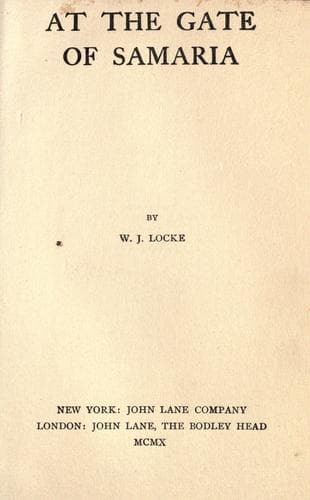
London (England) -- Fiction; Man-woman relationships -- Fiction; Women artists -- Fiction
“How delightful it is to dance with someone who is not bored by it!” she
said, when the music stopped and they were pushing their way through the
crowd towards the door.
He laughed in his boyish way, throwing back his head.
“I had better not answer that remark,” he replied.
“Why?”
She looked askance at him as she asked, just as any little peasant girl
would have done. Certain conditions bring all humanity to one level. He
pressed the hand that was on his arm lightly against his side.
“Let us get away by ourselves, and I will tell you,” he said.
But this opportunity did not occur. Thornton was captured by his hostess
for introducing purposes, Clytie waylaid by brother artists for dances.
When Thornton and herself were able to find seats the music struck up
the prelude of the next waltz, and Clytie was discovered and led off by
her partner. Only three men, exclusive of Thornton, had been fortunate
enough to find places on her programme.
The hours passed away swiftly. She forgot her life, her
responsibilities, her needs. During the three dances with the
fortunate--which were early in the evening--she flashed with wit and
merriment, her partners thinking with masculine self-esteem that they
were the fine steel that had caused these scintillations. But more
than one woman there that night observed how Clytie's eyes ever and anon
caught those of Thornton, who was standing by the doorway. When the two
danced together, men watched them curiously.
“If the principle of natural selection could always be carried out like
that!” said French, the journalist, to Redgrave.
“Physically, yes; but----”
“But what? If the human race sprang exclusively from such parents, what
a glorious race it would be!”
“It might be a very good thing for the race,” replied Redgrave drily;
“but I was thinking of the parents--at least of one of them.”
“Nonsense! a marriage like that would be ideal,” said French.
Redgrave shook his head.
“I doubt it,” he said, with some earnestness. “I know a little of Clytie
Davenant. I may claim to have discovered her. She has the blood of life
in her, it is true--but she has the finer artistic temperament as well.
Mark my words, French; if she marries that man she will lose her art
clean--clean; and not another 'Jack' will she ever be able to paint.
Many of us men artists are ruined by marriage. A woman artist, to whom
it means fifty times more, runs fifty times more risk.”
“Well, perhaps we are a bit previous,” said French laughing, and turned
the conversation.
Later in the evening Thornton and Clytie came out of the dancing-room.
She was flushed, dazed with the music, the noise, the electric light and
the heavy scent of cut flowers; confused, too, by Thornton's presence,
by the after-pressure of his arm around her waist, overwrought a little
by his personal magnetism.
Public-domain text, read in full here on John Shaqi.
Reviews
Reviews
No reviews yet
Be the first to share your thoughts on this work.
Elsewhere in the archive
Join the Discussion
Join the discussion
Sign in to leave a comment or review.
Sign InorCreate an account