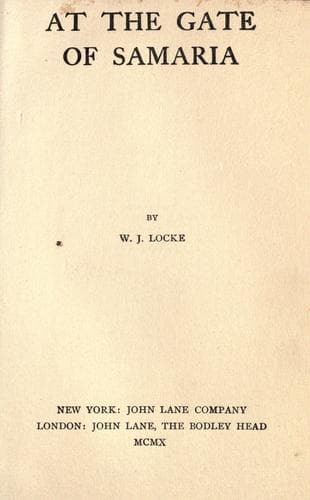
London (England) -- Fiction; Man-woman relationships -- Fiction; Women artists -- Fiction
Doth grossly clothe it in, we cannot hear it.
They followed so closely on the track of her own shuddering thought that
she could read no more. She blew out her candle, and remained awake,
staring into the darkness, until the gray dawn filtered through the
blinds, and she fell asleep.
Nor was Kent more restful. He had battled with his love, and with a
strong man's will had brought it under subjection, making it minister to
his happiness in spite of torturing longings instead of allowing it to
darken his life. It had awakened him to a sense of a world of beautiful
things, given him a deeper understanding and a wider sympathy than
he had before. For him truly might it be said that to love her was a
liberal education. It gave him the key to the knowledge and appreciation
of women, drew him from his seclusion into the general society he
had formerly avoided. A feminine conclusion which he would once have
pooh-poohed as weak and illogical struck him now with its intuitive
subtlety and delicacy of point. He learned that what the essentially
feminine mind lacks in breadth it gains in fineness, and he was
amazed to discover what a sensitive touch upon life is possessed by
a cultivated woman. And mingled with this new charm was another of an
esoteric kind. No woman he met had all the fascinations of Clytie, but
every woman seemed to possess one of them. He confided this once in a
roundabout way to Wither, who laughed, and told him he was growing too
susceptible and would find himself married one of these days. But Kent
shook his head. “I could only find a Clytie among them by marrying the
whole sex and making an extract of it,” he said with conviction. For not
only did the higher qualities of woman's nature manifest themselves to
him, but the minor graces of manner and appearance appealed to that side
of his aesthetic temperament that had hitherto been under a cloud. It
occurred to him then that he had been living with half his faculties.
Accordingly he felt a peculiar satisfaction in his new powers of
perception.
It had cost him a pang to forego the pleasure of the bright society that
Mrs. Farquharson gathered round her. At first he had given up going to
Harley Street through fear of meeting Clytie, for he shrank from meeting
her under the new conditions. Then as time passed on, and he accustomed
himself to the idea of Clytie as a married woman of fashion, he wished
to go, but shyness held him back. It would look strange to resume
visiting suddenly after his apparent rudeness and neglect. Probably the
Farquharsons would never have seen him again had not George met him at
a learned society's meeting, and given him a hearty and pressing
invitation.
Public-domain text, read in full here on John Shaqi.
Reviews
Reviews
No reviews yet
Be the first to share your thoughts on this work.
Elsewhere in the archive
Join the Discussion
Join the discussion
Sign in to leave a comment or review.
Sign InorCreate an account