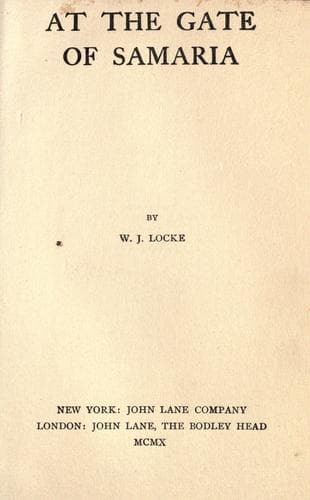
London (England) -- Fiction; Man-woman relationships -- Fiction; Women artists -- Fiction
A vague idea of raising Jack above the artisan level had occurred to her
during her scrutiny of his face. He was not an ordinary creature. That
he should spend his life in the dull, commonplace atmosphere of the
British workman seemed a waste of possibilities. There are millions who
possess just the qualifications for hewers of wood and drawers of water.
Why should a finer organisation not be cultivated, trained, put into an
environment where there are conditions for free development? But whether
the boy was a potential admiral, Lord Chancellor, or novelist she could
not determine. That was why she asked the question, “What could we make
of you?” somewhat pathetically. Jack shook his head in reply. He
had learned at school that life was a serious thing terminating in
apprenticeship.
“I've got to learn a trade,” he replied after a little, “and I'd sooner
be a carver and gilder than anything else.”
“But suppose a good fairy were to come, Jack,” persisted Clytie, “and
say that you were not to learn a trade, or that, if you did begin, you
would work your way out of it, and become a great man, and do glorious
things in the world--suppose you were able to choose to be anything
you liked--what do you think you would be? Tell me--something great and
bright and noble!”
She had grown animated with her enthusiasm, and leaned forward, with her
chin raised and lips parted--her attitude in moments of exaltation. The
boy looked at her for a few seconds, catching her spirit. Something
was at work within him too, for his eyes glowed, and his breath came
quickly.
“There is something, Jack. Tell me what it is!”
“I'd like to be a soldier like my father,” he said in a low voice, the
extravagant, glowing fancies that had haunted him for six months thus
finding half-choked expression.
“Your father?” asked Clytie, taken aback, and diverging into the side
track of her astonishment. “I never knew you had--I mean, I thought
you did not know anything at all about him. You used not to tell me the
truth, then, Jack.”
“Oh! but I did not know then!” he cried eagerly. “It was only when I
come here at Christmas, and you was ill, so I couldn't tell you. He
was a soldier, my father, an orficer. And I would like to be an orficer
too.”
“Really, Jack, this is very interesting,” said Clytie. “Aren't you
pleased to have a father you can be proud of? Was he a very brave man?”
“He had a sword,” said Jack proudly, as if that was proof positive of
valour.
“Come and sit down in your old place on the hearthrug and tell me all
about him.”
The boy did as he was bidden, sinking somewhat shyly at first on to the
great bearskin at Clytie's feet. But after a while he huddled himself up
in his old posture.
Public-domain text, read in full here on John Shaqi.
Reviews
Reviews
No reviews yet
Be the first to share your thoughts on this work.
Elsewhere in the archive
Join the Discussion
Join the discussion
Sign in to leave a comment or review.
Sign InorCreate an account