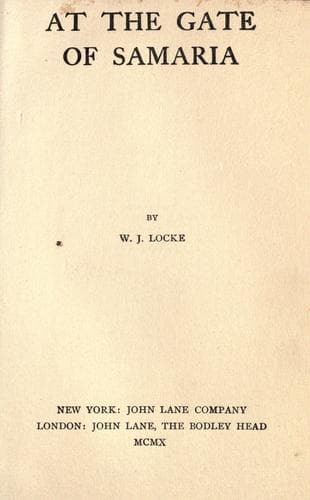
London (England) -- Fiction; Man-woman relationships -- Fiction; Women artists -- Fiction
Indeed, as is the case with hundreds of our upper middle-class families,
the Davenants had descended from a fierce old Puritan stock, and though
the reality of their Puritanism had gradually lost itself in the current
of more respectable orthodoxy, its shadow hung over them still. The
vigorous enthusiasm that spurred the Puritan on to lofty action
was gone; the vague dread of sin that kept him in moral and mental
inactivity alone remained. Perhaps it is this survival amongst us of
the negative element of Puritanism that produces in England the curious
anomaly of education without enlightenment. It has dulled our perception
of life as an art, whose “great incidents,” as Fielding finely says,
“are no more to be considered as mere accidents than the several
members of a fine statue or a noble poem.” It has caused us to live in
a perpetual twilight in which the possibilities of existence loom
fantastic and indistinct. The Davenants were gentlefolk, holding a good
position in the small country town of Durdleham; they visited among
the county families, and, on ordinary, conventional grounds, considered
themselves to belong to the cultured classes. They were the curious yet
familiar product of the old-fashioned, high-church Toryism impregnated
with the Puritan taint.
The light was fading through the French window behind the old man's
chair. He laid down the canvas on his lap and looked in a puzzled way at
the fire. Then he raised it nearer to his eyes for further examination.
“This is really very dreadful,” he said at last, looking at his
daughter.
“Something will have to be done soon,” replied the latter.
“It is so horribly vulgar, Grace,” said the old man; “look at that boy's
nose--and that drunken man--his face is a nightmare of evil. I really
must begin to talk seriously to Clytie.”
Mrs. Blather smiled somewhat pityingly. Since the earliest days of her
long widowhood she had undertaken the charge of her father's house and
the care of her two younger sisters, Janet and Clytie. Her familiarity,
therefore, with the seamy side of Clytie's nature had been of long
duration.
“You might as well talk to that fender, papa,” she said. “Clytie has
got it into her head that she is going to be an artist, and no amount of
talking will get it out.”
“It's all through her visiting those friends of hers, the Farquharsons.
They are not nice people for her to know. I shall not let her go there
again.”
“If she goes on like this there is no knowing what will happen.”
“Where did the child get these repulsive and ungirlish notions from?”
the old man asked querulously.
Public-domain text, read in full here on John Shaqi.
Reviews
Reviews
No reviews yet
Be the first to share your thoughts on this work.
Join the Discussion
Join the discussion
Sign in to leave a comment or review.
Sign InorCreate an account