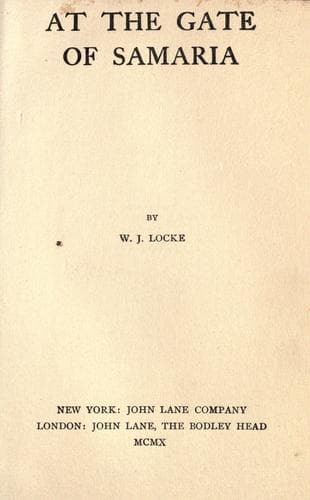
London (England) -- Fiction; Man-woman relationships -- Fiction; Women artists -- Fiction
“Why, of course, darling,” said Winnie, coming up and giving her a
farewell kiss. “I hate to think the studio isn't yours.”
So Winifred went away and they remained as in the old days. The sudden
association gave Clytie a pang. A reaction from her enthusiasm about
Jack to weariness of spirit made her sink back listlessly in her chair.
“What is the matter?” asked Kent, filling his pipe. “You are not looking
yourself. It is this steaming London. Why don't you go and get some
country air?”
“Oh, one place is just the same as another. It isn't London and it isn't
the weather. It is the world that is out of joint, somehow. I am afraid
I have been moping. I think I shall invest in a cat. Then I can pour out
my grievances to it. That's the best of a cat: it never mopes. It goes
on purring cheerfully so long as it's warm and well fed, and when you
feel paradoxical it never worries you to explain yourself. Do you like
cats? I forget.”
“What are you moping about?” he asked between the first few puffs of his
kindling pipe.
“Oh, don't talk in that aggressively cheerful tone, Kent. I have come on
all over moods, and I want comforting.”
“You should work,” replied Kent with some self-restraint. “You have
hardly touched a brush in earnest this year. It is the claims of that
part of your nature that cry out if they are not satisfied. Why don't
you go on painting? What has the fact of your not having to make your
living got to do with your art?”
“Everything, in a way,” she murmured.
“I can't believe it,” said Kent earnestly. “You are not the woman to
neglect your art out of pure idleness. Come, Clytie, rouse yourself and
paint a great picture. The 'Faustina'--what has become of that?”
“Oh, don't, don't!” she cried, putting her hands up before her face. “I
can't do that now--can't think of it. Years hence, perhaps, when I am
a middle-aged woman, if I find it good enough to live till then, I may
try--but not now.”
Kent laid down his pipe and drew his chair near to her. He was pained
and troubled. He saw that her nerves were a little unstrung; but the
Clytie he knew was the last woman in the world to give way to attacks of
this kind. And then a dreary conjecture dawned upon him, and his heart
sank.
“My poor Clytie!” he said in his kind way. “You seem unhappy. I wish I
could do something to help you.”
“Ah! it's too late now,” she said impulsively, scarcely heeding the
purport of her words. “You might have done it eighteen months ago--if
you had not been quixotic.”
“What do you mean?” he asked, more and more troubled and at fault.
“Eighteen months ago? How could I have helped you? I loved you and hid
it from you. I could only have caused you pain. I love you now. I don't
hide it. Why should I? I am ready to help you if I can. I am stronger,
wiser now than I was then. How could I have helped you then?”
The simplicity of his short, reiterative sentences and the sincerity of
his tone went to her heart, “You could have helped me then by not hiding
it.”
Public-domain text, read in full here on John Shaqi.
Reviews
Reviews
No reviews yet
Be the first to share your thoughts on this work.
Elsewhere in the archive
Join the Discussion
Join the discussion
Sign in to leave a comment or review.
Sign InorCreate an account