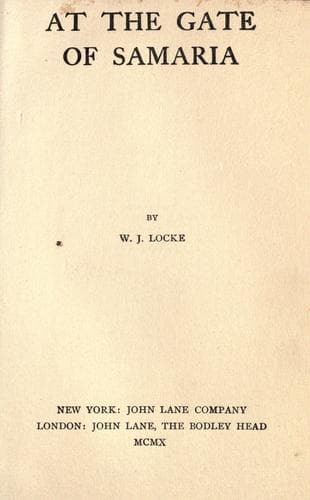
London (England) -- Fiction; Man-woman relationships -- Fiction; Women artists -- Fiction
She went, as of old, into the streets for her models, choosing the side
of life least understanded of Philistia, sublimating that which was
spiritual, eternal in abject and outcast, beggar and courtesan. Strange
were the walks of Kent and herself about the great city, by day and by
night, and strange the spars and fragments of humanity they picked up in
these rambles, who found their way afterwards to Clytie's studio. They
went together to East End music halls, bank holiday gatherings, thieves'
kitchens, night clubs in the West End, where ladies are admitted free
on a member's introduction, Kent paying his subscription almost at the
door. It was towards women that Clytie's sympathy flowed the strongest.
Her first contact with one of _ces autres_ in the hotel at Dinan had set
a chord vibrating within her that now rang out full and true. She could
paint these women, young, withered, children on the lurid threshold,
old women with charred and blackened past. It is the moralist's part to
condemn, evolve the moral; the artist on the higher plane disintegrates
the spiritual from the animal and presents it in the form of Truth. From
the comedy of misery, the tragedy of sex, the never ending drama of vice
and crime, the one draws groans, the other tears. Each has his place
in the cosmos. Thus Clytie, artist and woman, walked through the
abomination of desolation and opened the eyes of the world to the
glimmering spiritual rays that shot across it.
Once more she took out the studies she had made for the “Faustina”
picture. This time she could look on them without a shudder, only sadly.
The picture would never be painted. She was no longer in feverish,
passionate search after mysteries that had baffled her. The picture now
had no artistic reason for existence. It would be a cruel, despairing
work, a tragedy of cynicism. Knowledge of the world had given her
knowledge of self; she knew now how blent were the foreshadowings of
passion in her own soul with those that she had hungered to express on
the young face of Faustina. In those days she could have found a model
in her own mirror, and then the personal note dominating the picture
would have saved it from heartlessness. For the complete woman to paint
it would be the presentation of the damnation of a young soul. But the
contemplation of her earlier work suggested vividly the converse of
the subject--a Faustina swept away by the whirl of passion with the
after-light of innocence in her soul's depths. The conception grew
within her, took form, awoke the full artist in the ripe woman. With a
throbbing sense of mastery, a quivering thrill of inspiration, new to
her as the first love kiss on a young girl's lips, she betook herself to
her task.
Public-domain text, read in full here on John Shaqi.
Reviews
Reviews
No reviews yet
Be the first to share your thoughts on this work.
Elsewhere in the archive
Join the Discussion
Join the discussion
Sign in to leave a comment or review.
Sign InorCreate an account