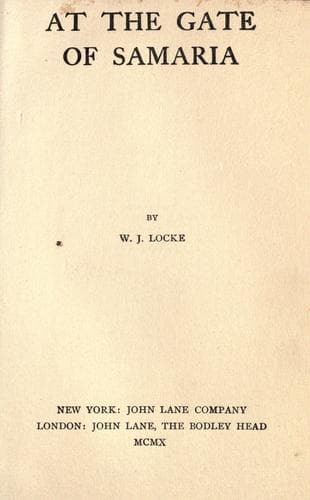
London (England) -- Fiction; Man-woman relationships -- Fiction; Women artists -- Fiction
To the imaginative there was much that was heroic and romantic in the
record of the active life of Thornton Hammerdyke. He had entered the
army shortly after leaving school, but, wearying after a couple of
years of the dulness of a garrison life, had resigned his commission.
An exploring party to Thibet was afoot. He joined it, quickly became its
leading spirit, and when the chief of the expedition was incapacitated
through illness he undertook the command. This brought him into public
notice. When the Soudan War broke out he joined Lord Wolseley as a
volunteer, and made himself conspicuous by his daring and his marvellous
feats of bodily strength. His name was known all through the army.
He courted danger, especially where it took the form of hand to hand
fighting. An eye-witness of the scene had told Caroline how once, when
attacked by three gigantic Soudanese, he had shorn one clean through the
body, lost his sword, leaped from his horse, wrenched the spear from
one of the others with a force that made the man's arm snap like a twig,
turn on the other--while the broken-armed savage leaped upon his back
and tried to throttle him--and how before there was time to follow his
movements both were lying dead at his feet. He had fought side by side
with Burnaby in the rash conflict when the author of the “Ride to Khiva”
fell pierced with Soudanese spears. He had been in evidence in every
skirmish. When the war was over he remained in Africa, on the Soudan
frontier, in command of some Egyptian cavalry, maintaining a guerrilla
warfare until the troops were recalled. And then he plunged into the
interior, exploring on his own account, with a nominal authority from
the Belgian government. And it was on this part of his career that his
reputation chiefly rested. Certainly ugly stories against him of undue
harshness, even ferocity, were afloat at one time. But he laughed at
these rumours on his return to England, and sarcastically observed in a
letter to the _Times_ that, given a community consisting of a judge, a
prisoner, and a hundred howling, savage maniacs, it was a matter of some
difficulty to form an impartial jury.
When Mrs. Farquharson and Clytie arrived at Harley Street the short
January day had nearly drawn to a close. In the drawing-room the gas
had not been lighted, and by the dull glow of the fire objects were only
dimly visible. Two men rose from either side of the hearth as the ladies
entered. The long ungainly figure Clytie recognised as Mr. Farquharson,
the other as Thornton Hammerdyke, from Caroline's description of his
great powerful frame. His face she could not distinguish; only a large,
finely shaped head, and white teeth gleaming under a heavy moustache as
he exchanged laughing greetings with his cousin.
Mrs. Farquharson performed the little ceremony of introduction. Then tea
was brought in.
Public-domain text, read in full here on John Shaqi.
Reviews
Reviews
No reviews yet
Be the first to share your thoughts on this work.
Elsewhere in the archive
Join the Discussion
Join the discussion
Sign in to leave a comment or review.
Sign InorCreate an account