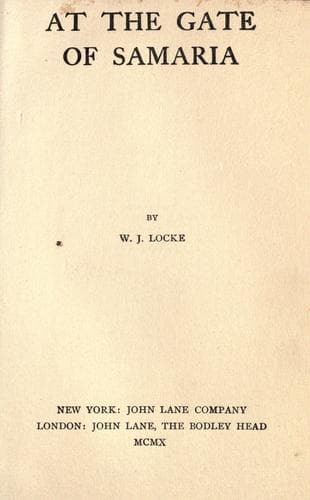
London (England) -- Fiction; Man-woman relationships -- Fiction; Women artists -- Fiction
“You will excuse this outer darkness, Clytie,” said Caroline. “George
thinks it soothing. You know his ways. You see what a poor woman has to
put up with!”
“I agree with him,” said Clytie. “It is cosy, and it seems to sanction
foolish gossip.”
“Did you ever hear me gossip?” asked Mr. Farquharson severely. “I like
it, Miss Davenant, because it induces a meditative frame of mind.”
“And slumber,” murmured his wife as she dispensed the tea.
The talk continued light and easy, on the topics of the day, the
studios, Thornton's plans for the enjoyment of civilised life. He spoke
brightly, in a deep, resonant voice, that of a man assured of himself
and of the interest afforded to others by reference to his own doings.
Although the subject was trivial, the others listened amusedly, carried
away by the influence of a strong personality. Clytie glanced at
him from time to time, trying to measure him, to sum him up in the
instinctive feminine way. But he was sitting far back from the fire, in
the gloom, and she could only gather a general impression of physical
size and vitality. She was conscious too, that, as she was sitting with
her face in the direct glow, she was visible to him, and that he was
looking at her quietly as he smoked his cigarette and talked. She picked
up a newspaper from a little table by her side, and held it before
her face as a screen. His glance, which she felt rather than met,
embarrassed her, she scarcely knew why. Gradually the talk drifted into
a slight discussion between the two men. Mrs. Farquharson took advantage
of it to draw her chair near to Clytie.
“And all this time I have scarcely asked you a question about yourself.
Come, account to me for the six weeks you have been away.”
Clytie dutifully went over the main incidents of her stay in Durdleham,
making light, in her pleasure at being in London again, of the little
wearinesses and depressions of the past. A faint cloud came over her
gaiety when Mrs. Farquharson asked her suddenly:
“And Kent? What has become of him?”
“He is still alive,” said Clytie.
“Do you know, he has not been near us all the time you have been away.
He has treated us very badly. You must scold him for me. What has he to
say for himself?”
“I don't know; I haven't seen him yet, and I have scarcely heard
from him. I shall have to scold him on my own account,” she added,
brightening.
“That's odd of him,” said Caroline. “You are such inseparables that I
thought he would have been waiting for you with a bouquet in each hand
when you entered the house.”
Clytie laughed at the idea of Kent waiting for her with Covent Garden
tributes.
“I would just as soon think of him reading me a sonnet. But I did expect
him to come down to tell me I had been wasting my time, and to draw out
a scheme for the better occupation of it.”
“Take care that he has not gone and fallen in love with somebody whilst
he has been left to his own devices,” said Caroline teasingly.
Public-domain text, read in full here on John Shaqi.
Reviews
Reviews
No reviews yet
Be the first to share your thoughts on this work.
Elsewhere in the archive
Join the Discussion
Join the discussion
Sign in to leave a comment or review.
Sign InorCreate an account