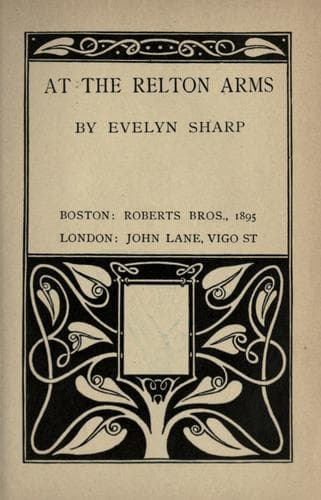
England -- Social life and customs -- 19th century -- Fiction
After that he also shut the window and went to bed, where he likewise
slept soundly till the morning.
CHAPTER IV.
The "Relton Arms" had the reputation of being the most respectable inn
in the little country town of Relton. It had no particular right to this
title, being smaller and more shabby than the "Red Lion" down the
street, which was a modern innovation run by a speculator from the
neighboring market-town, and promised particular advantages to cyclists
which they never quite seemed to reap; but it had outlived generations
of Reltons up at the old Court, and it bore their family escutcheon on
its sign-board, and all the club dinners were held in its oak-panelled
parlor; and the frequent presence of the rector on occasions when
alcohol was banished from the table had naturally helped it to keep up
its reputation. The fallacy was maintained equally strangely by the
silence of its landlord, who only grew more taciturn as he grew more
intoxicated, while the people who were fond of talking, notably his
wife, made capital out of his silence and applauded him for it, so that
he too became respectable in the eyes of Relton. And never having been
known to contradict any one in his life, respectable he accordingly
consented to remain.
It was on a sultry, still afternoon towards the end of the summer that
Roger Brill, the comely rat-catcher of the town, raised the latch of the
"Relton Arms" about tea-time.
"Mornin', missus," said he.
"And I'm sure it's mornin' to you, Muster Brill, notwithstandin' it's
being arternoon by time o'sun, which be a foolish difference to make
among old acquaintance; but there, there's a deal too much talkin' about
trifles in my thinkin'. And be you ready for a cup of tea, lad, or be it
the usual you'll be wantin'?"
Without waiting for the reply, which had been the same, like the
question, for the last fifteen years, the bustling landlady hastened
forward with a chair and sent her obedient husband for the beer. One of
the most remarkable phases of a monotonous incident is the way in which
some people contrive to give it the appearance of novelty. Mrs. Haxtell
belonged to such a class, and it did not in the least disturb her method
that her husband had usually filled the pewter pot before she had
finished inviting her customer to have it. But old Peter was a man of
deeds, not words, and he chose for his part to make the transaction a
purely business one, though he allowed his wife to hide it with a veneer
of hospitality if she would. And this she generally did in the most
feminine and transparent manner possible, until the time for payment
came, when she would meekly retire under cover of her sex, and leave her
husband to battle with the creditor.
"Good sport to-day, lad?" asked Peter presently.
"Aye, for sure," answered Roger; and then, glancing professionally at
the row of dead rats that hung from his waist, he added slowly, "more
ways nor one."
"Eh," said Peter, with a slight access of emphasis.
Public-domain text, read in full here on John Shaqi.
Reviews
Reviews
No reviews yet
Be the first to share your thoughts on this work.
Join the Discussion
Join the discussion
Sign in to leave a comment or review.
Sign InorCreate an account