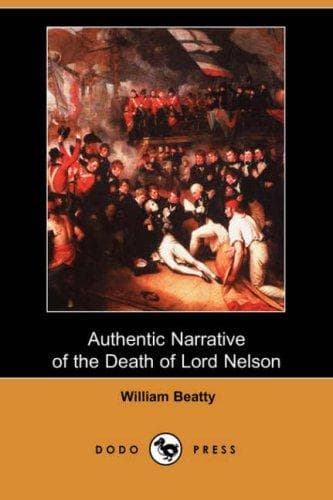
Authentic Narrative of the Death of Lord NelsonBeatty, William
History
Authentic Narrative of the Death of Lord Nelson
Beatty, William
Admirals -- Great Britain -- Biography; Nelson, Horatio Nelson, Viscount, 1758-1805 -- Death and burial
the fact; when HIS LORDSHIP said, "Ah, BEATTY! I am too certain of it:
SCOTT and BURKE have tried it already. _You know_ I am gone." The
Surgeon replied: "My Lord, unhappily for our Country, nothing can be
done for you;" and having made this declaration he was so much affected,
that he turned round and withdrew a few steps to conceal his emotions.
HIS LORDSHIP said: "I know it. I feel something rising in my breast,"
putting his hand on his left side, "which tells me I am gone." Drink was
recommended liberally, and Doctor SCOTT and Mr. BURKE fanned him with
paper. He often exclaimed, "GOD be praised, I have done my duty;" and
upon the Surgeon's inquiring whether his pain was still very great, he
declared, "it continued so very severe, that he wished he was dead.
Yet," said he in a lower voice, "one would like to live a little longer,
too:" and after a pause of a few minutes, he added in the same tone,
"What would become of poor Lady HAMILTON, if she knew my situation!"
THE Surgeon, finding it impossible to render HIS LORDSHIP any further
assistance, left him, to attend Lieutenant BLIGH, Messrs. SMITH and
WESTPHALL Midshipmen, and some Seamen, recently wounded. Captain HARDY
now came to the cockpit to see HIS LORDSHIP a second time, which was
after an interval of about fifty minutes from the conclusion of his
first visit. Before he quitted the deck, he sent Lieutenant HILLS to
acquaint Admiral COLLINGWOOD with the lamentable circumstance of Lord
NELSON'S being wounded.[14]--Lord NELSON and Captain HARDY shook hands
again: and while the Captain retained HIS LORDSHIP'S hand, he
congratulated him even in the arms of Death on his brilliant victory;
"which," he said, "was complete; though he did not know how many of the
Enemy were captured, as it was impossible to perceive every ship
distinctly. He was certain however of fourteen or fifteen having
surrendered." HIS LORDSHIP answered, "That is well, but I bargained for
twenty:" and then emphatically exclaimed, "_Anchor_, HARDY, _anchor_!"
To this the Captain replied: "I suppose, my Lord, Admiral COLLINGWOOD
will now take upon himself the direction of affairs."--"Not while I
live, I hope, HARDY!" cried the dying Chief; and at that moment
endeavoured ineffectually to raise himself from the bed. "No," added he;
"do _you_ anchor, HARDY." Captain HARDY then said: "Shall _we_ make the
signal, Sir?"--"Yes," answered HIS LORDSHIP; "for if I live, I'll
anchor."[15] The energetic manner in which he uttered these his last
orders to Captain HARDY, accompanied with his efforts to raise himself,
evinced his determination never to resign the command while he retained
the exercise of his transcendant faculties, and that he expected Captain
HARDY still to carry into effect the suggestions of his exalted mind; a
sense of his duty overcoming the pains of death. He then told Captain
HARDY, "he felt that in a few minutes he should be no more;" adding in a
Public-domain text, read in full here on John Shaqi.
Reviews
Reviews
No reviews yet
Be the first to share your thoughts on this work.
Join the Discussion
Join the discussion
Sign in to leave a comment or review.
Sign InorCreate an account