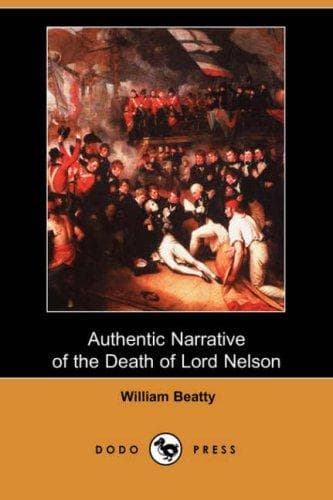
Authentic Narrative of the Death of Lord NelsonBeatty, William
History
Authentic Narrative of the Death of Lord Nelson
Beatty, William
Admirals -- Great Britain -- Biography; Nelson, Horatio Nelson, Viscount, 1758-1805 -- Death and burial
The Remains were wrapped in cotton vestments, and rolled from head to
foot with bandages of the same material, in the ancient mode of
embalming. The Body was then put into a leaden coffin, filled with
brandy holding in solution camphor and myrrh.[28] This coffin was
inclosed in a wooden one, and placed in the after-part of HIS LORDSHIP'S
cabin; where it remained till the 21st of December, when an order was
received from the Admiralty for the removal of the Body. The coffin that
had been made from the mainmast of the French Commander's ship L'Orient,
and presented to HIS LORDSHIP by his friend Captain HOLLOWELL, after
the battle of the Nile, being then received on board, the leaden coffin
was opened, and the Body taken out; when it was found still in most
excellent condition, and completely plastic. The features were somewhat
tumid, from absorption of the spirit; but on using friction with a
napkin, they resumed in a great degree their natural character. All the
Officers of the ship, and several of HIS LORDSHIP'S friends, as well as
some of Captain HARDY'S, who had come on board the Victory that day from
the shore, were present at the time of the Body's being removed from the
leaden coffin; and witnessed its undecayed state after a lapse of two
months since death, which excited the surprise of all who beheld it.
This was the last time the mortal part of the lamented Hero was seen by
human eyes; as the Body, after being dressed in a shirt, stockings,
uniform small-clothes and waistcoat, neckcloth, and night-cap, was then
placed in the shell made from L'Orient's mast, and covered with the
shrouding. This was inclosed in a leaden coffin; which was soldered up
immediately, and put into another wooden shell: in which manner it was
sent out of the Victory into Commissioner GREY'S yacht, which was hauled
alongside for that purpose. In this vessel the revered Remains were
conveyed to Greenwich Hospital; attended by the Reverend Doctor SCOTT,
and Messrs. TYSON and WHITBY.
LORD NELSON had often talked with Captain HARDY on the subject of his
being killed in battle, which appeared indeed to be a favourite topic of
conversation with him. He was always prepared to lay down his life in
the service of his Country; and whenever it should please Providence to
remove him from this world, it was the most ambitious wish of his soul
to die in the fight, and in the very hour of a great and signal victory.
In this he was gratified: his end was glorious; and he died as he had
lived, one of the greatest among men.
The following Prayer, found in HIS LORDSHIP'S memorandum-book,--and
written with his own hand on the night of his leaving Merton, at one of
the places where he changed horses (supposed to be Guildford) on his way
to join the Victory at Portsmouth,--is highly illustrative of those
sentiments of combined piety and patriotic heroism with which he was
inspired:
_"Friday Night, 13th September_.
Public-domain text, read in full here on John Shaqi.
Reviews
Reviews
No reviews yet
Be the first to share your thoughts on this work.
Join the Discussion
Join the discussion
Sign in to leave a comment or review.
Sign InorCreate an account