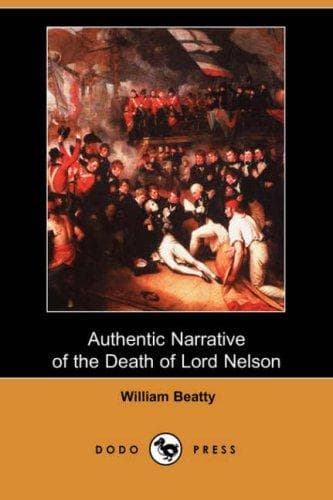
Authentic Narrative of the Death of Lord NelsonBeatty, William
History
Authentic Narrative of the Death of Lord Nelson
Beatty, William
Admirals -- Great Britain -- Biography; Nelson, Horatio Nelson, Viscount, 1758-1805 -- Death and burial
The boats on the quarters of the ship, being found in the way of the
guns, were now lowered, down, and towed astern. Captain BLACKWOOD, of
the Euryalus, remained on board the Victory till a few minutes before
the Enemy began to fire upon her. He represented to His LORDSHIP, that
his flag-ship would be singled out and much pressed by the Enemy; and
suggested the propriety therefore of permitting one or two ships of his
line to go ahead of the Victory, and lead her into action, which might
be the means of drawing in some measure the Enemy's attention from her.
To this Lord NELSON assented, and at half past nine o'clock he ordered
the Temeraire and Leviathan by signal (the former of which ships, being
close to the Victory, was hailed by His LORDSHIP) to go ahead for that
purpose; but from the light breeze that prevailed they were unable,
notwithstanding their utmost efforts, to attain their intended stations.
Captain BLACKWOOD foresaw that this would be the case; and as the
Victory still continued to carry all her sail, he wished Captain HARDY
to acquaint His LORDSHIP, that unless her sail was in some degree
shortened, the two ships just mentioned could not succeed in getting
ahead previously to the Enemy's line being forced: this however Captain
HARDY declined doing, as he conceived His LORDSHIP'S ardour to get into
battle would on no account suffer such a measure.[9]
About half an hour before the Enemy opened their fire, the memorable
telegraphic signal was made, that "ENGLAND EXPECTS EVERY MAN WILL DO HIS
DUTY," which was spread and received throughout the Fleet with
enthusiasm. It is impossible adequately to describe by any language, the
lively emotions excited in the crew of the Victory when this propitious
communication was made known to them: confidence and resolution were
strongly pourtrayed in the countenance of all; and the sentiment
generally expressed to each other was, that they would prove to their
Country that day, how well British seamen _could_ "do their duty" when
led to battle by their revered Admiral. The signal was afterwards made
to "prepare to anchor after the close of the day;" and union-jacks were
hoisted at the fore-topmast and top-gallant-stays of each ship, to serve
as a distinction from the Enemy's, in conformity with orders previously
issued by the Commander in Chief. By HIS LORDSHIP'S directions also, the
different divisions of the Fleet hoisted the St. George's or white
ensign, being the colours of the Commander in Chief: this was done to
prevent confusion from occurring during the battle, through a variety of
national flags.
Public-domain text, read in full here on John Shaqi.
Reviews
Reviews
No reviews yet
Be the first to share your thoughts on this work.
Join the Discussion
Join the discussion
Sign in to leave a comment or review.
Sign InorCreate an account