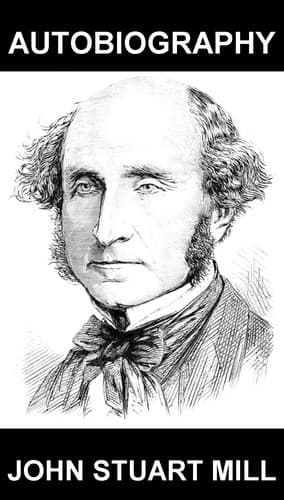
Mill, John Stuart, 1806-1873; Philosophers -- England -- Biography
I am thus one of the very few examples, in this country, of one who has
not thrown off religious belief, but never had it: I grew up in a
negative state with regard to it. I looked upon the modern exactly as
I did upon the ancient religion, as something which in no way concerned
me. It did not seem to me more strange that English people should believe
what I did not, than that the men I read of in Herodotus should have done
so. History had made the variety of opinions among mankind a fact familiar
to me, and this was but a prolongation of that fact. This point in my
early education had, however, incidentally one bad consequence deserving
notice. In giving me an opinion contrary to that of the world, my father
thought it necessary to give it as one which could not prudently be avowed
to the world. This lesson of keeping my thoughts to myself, at that early
age, was attended with some moral disadvantages; though my limited
intercourse with strangers, especially such as were likely to speak to
me on religion, prevented me from being placed in the alternative of
avowal or hypocrisy. I remember two occasions in my boyhood, on which I
felt myself in this alternative, and in both cases I avowed my disbelief
and defended it. My opponents were boys, considerably older than myself:
one of them I certainly staggered at the time, but the subject was never
renewed between us: the other who was surprised and somewhat shocked, did
his best to convince me for some time, without effect.
The great advance in liberty of discussion, which is one of the most
important differences between the present time and that of my childhood,
has greatly altered the moralities of this question; and I think that
few men of my father's intellect and public spirit, holding with such
intensity of moral conviction as he did, unpopular opinions on religion,
or on any other of the great subjects of thought, would now either
practise or inculcate the withholding of them from the world, unless in
the cases, becoming fewer every day, in which frankness on these subjects
would either risk the loss of means of subsistence, or would amount to
exclusion from some sphere of usefulness peculiarly suitable to the
capacities of the individual. On religion in particular the time appears
to me to have come when it is the duty of all who, being qualified in
point of knowledge, have on mature consideration satisfied themselves
that the current opinions are not only false but hurtful, to make their
dissent known; at least, if they are among those whose station or
reputation gives their opinion a chance of being attended to. Such an
avowal would put an end, at once and for ever, to the vulgar prejudice,
that what is called, very improperly, unbelief, is connected with any
bad qualities either of mind or heart. The world would be astonished if
it knew how great a proportion of its brightest ornaments--of those most
distinguished even in popular estimation for wisdom and virtue--are
Public-domain text, read in full here on John Shaqi.
Reviews
Reviews
No reviews yet
Be the first to share your thoughts on this work.
Join the Discussion
Join the discussion
Sign in to leave a comment or review.
Sign InorCreate an account