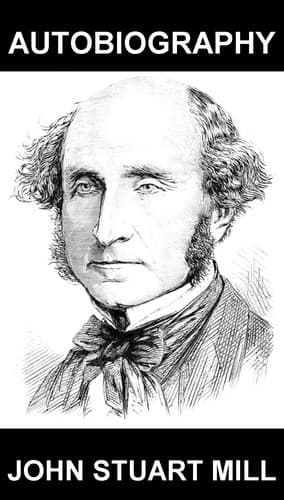
Mill, John Stuart, 1806-1873; Philosophers -- England -- Biography
the greatest poets, he may be said to be the poet of unpoetical natures,
possessed of quiet and contemplative tastes. But unpoetical natures are
precisely those which require poetic cultivation. This cultivation
Wordsworth is much more fitted to give, than poets who are intrinsically
far more poets than he.
It so fell out that the merits of Wordsworth were the occasion of my
first public declaration of my new way of thinking, and separation from
those of my habitual companions who had not undergone a similar change.
The person with whom at that time I was most in the habit of comparing
notes on such subjects was Roebuck, and I induced him to read
Wordsworth, in whom he also at first seemed to find much to admire: but
I, like most Wordsworthians, threw myself into strong antagonism to
Byron, both as a poet and as to his influence on the character. Roebuck,
all whose instincts were those of action and struggle, had, on the
contrary, a strong relish and great admiration of Byron, whose writings
he regarded as the poetry of human life, while Wordsworth's, according
to him, was that of flowers and butterflies. We agreed to have the fight
out at our Debating Society, where we accordingly discussed for two
evenings the comparative merits of Byron and Wordsworth, propounding and
illustrating by long recitations our respective theories of poetry:
Sterling also, in a brilliant speech, putting forward his particular
theory. This was the first debate on any weighty subject in which
Roebuck and I had been on opposite sides. The schism between us widened
from this time more and more, though we continued for some years longer
to be companions. In the beginning, our chief divergence related to the
cultivation of the feelings. Roebuck was in many respects very different
from the vulgar notion of a Benthamite or Utilitarian. He was a lover of
poetry and of most of the fine arts. He took great pleasure in music, in
dramatic performances, especially in painting, and himself drew and
designed landscapes with great facility and beauty. But he never could
be made to see that these things have any value as aids in the formation
of character. Personally, instead of being, as Benthamites are supposed
to be, void of feeling, he had very quick and strong sensibilities. But,
like most Englishmen who have feelings, he found his feelings stand very
much in his way. He was much more susceptible to the painful sympathies
than to the pleasurable, and, looking for his happiness elsewhere, he
wished that his feelings should be deadened rather than quickened. And,
in truth, the English character, and English social circumstances, make
it so seldom possible to derive happiness from the exercise of the
sympathies, that it is not wonderful if they count for little in an
Englishman's scheme of life. In most other countries the paramount
importance of the sympathies as a constituent of individual happiness is
an axiom, taken for granted rather than needing any formal statement;
Public-domain text, read in full here on John Shaqi.
Reviews
Reviews
No reviews yet
Be the first to share your thoughts on this work.
Elsewhere in the archive
Join the Discussion
Join the discussion
Sign in to leave a comment or review.
Sign InorCreate an account