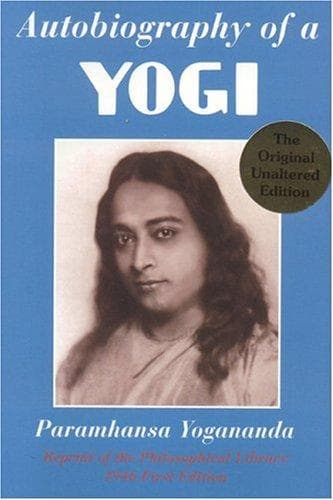
Yogananda, Paramahansa, 1893-1952; Yogis -- India -- Biography
The Western day is indeed nearing when the inner science of self-control
will be found as necessary as the outer conquest of nature. This
new Atomic Age will see men’s minds sobered and broadened by the
now scientifically indisputable truth that matter is in reality a
concentrate of energy. Finer forces of the human mind can and must
liberate energies greater than those within stones and metals, lest
the material atomic giant, newly unleashed, turn on the world in
mindless destruction. {FN24-9}
{FN24-1} I CORINTHIANS 7:32-33.
{FN24-2} Literally, “This soul is Spirit.” The Supreme Spirit,
the Uncreated, is wholly unconditioned (NETI, NETI, not this, not
that) but is often referred to in VEDANTA as SAT-CHIT-ANANDA, that
is, Being-Intelligence-Bliss.
{FN24-3} Sometimes called Shankaracharya. ACHARYA means “religious
teacher.” Shankara’s date is a center of the usual scholastic dispute.
A few records indicate that the peerless monist lived from 510 to
478 B.C.; Western historians assign him to the late eighth century
A.D. Readers who are interested in Shankara’s famous exposition
of the BRAHMA SUTRAS will find a careful English translation in Dr.
Paul Deussen’s SYSTEM OF THE VEDANTA (Chicago: Open Court Publishing
Company, 1912). Short extracts from his writings will be found in
SELECTED WORKS OF SRI SHANKARACHARYA (Natesan & Co., Madras).
{FN24-4} “CHITTA VRITTI NIRODHA”-YOGA SUTRA I:2. Patanjali’s date
is unknown, though a number of scholars place him in the second
century B.C. The rishis gave forth treatises on all subjects with
such insight that ages have been powerless to outmode them; yet,
to the subsequent consternation of historians, the sages made no
effort to attach their own dates and personalities to their literary
works. They knew their lives were only temporarily important as
flashes of the great infinite Life; and that truth is timeless,
impossible to trademark, and no private possession of their own.
{FN24-5} The six orthodox systems (SADDARSANA) are SANKHYA, YOGA,
VEDANTA, MIMAMSA, NYAYA, and VAISESIKA. Readers of a scholarly bent
will delight in the subtleties and broad scope of these ancient
formulations as summarized, in English, in HISTORY OF INDIAN
PHILOSOPHY, Vol. I, by Prof. Surendranath DasGupta (Cambridge
University Press, 1922).
{FN24-6} Not to be confused with the “Noble Eightfold Path” of
Buddhism, a guide to man’s conduct of life, as follows (1) Right
Ideals, (2) Right Motive, (3) Right Speech, (4) Right Action, (5)
Right Means of Livelihood, (6) Right Effort, (7) Right Remembrance
(of the Self), (8) Right Realization (SAMADHI).
{FN24-7} Dr. Jung attended the Indian Science Congress in 1937 and
received an honorary degree from the University of Calcutta.
Public-domain text, read in full here on John Shaqi.
Reviews
Reviews
No reviews yet
Be the first to share your thoughts on this work.
Elsewhere in the archive
Join the Discussion
Join the discussion
Sign in to leave a comment or review.
Sign InorCreate an account