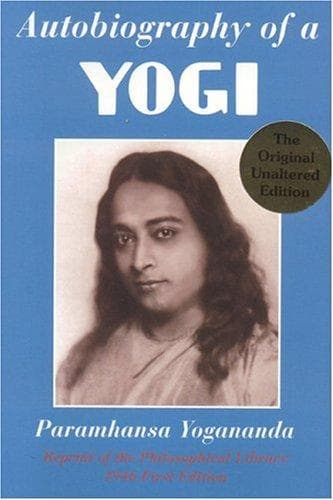
Yogananda, Paramahansa, 1893-1952; Yogis -- India -- Biography
There are a number of great souls, living in American or European
or other non-Hindu bodies today who, though they may never have
heard the words YOGI and SWAMI, are yet true exemplars of those
terms. Through their disinterested service to mankind, or through
their mastery over passions and thoughts, or through their single
hearted love of God, or through their great powers of concentration,
they are, in a sense, yogis; they have set themselves the goal of
yoga-self-control. These men could rise to even greater heights if
they were taught the definite science of yoga, which makes possible
a more conscious direction of one’s mind and life.
Yoga has been superficially misunderstood by certain Western
writers, but its critics have never been its practitioners. Among
many thoughtful tributes to yoga may be mentioned one by Dr. C. G.
Jung, the famous Swiss psychologist.
“When a religious method recommends itself as ‘scientific,’ it can
be certain of its public in the West. Yoga fulfills this expectation,”
Dr. Jung writes. {FN24-7} “Quite apart from the charm of the new,
and the fascination of the half-understood, there is good cause
for Yoga to have many adherents. It offers the possibility of
controllable experience, and thus satisfies the scientific need
of ‘facts,’ and besides this, by reason of its breadth and depth,
its venerable age, its doctrine and method, which include every
phase of life, it promises undreamed-of possibilities.
“Every religious or philosophical practice means a psychological
discipline, that is, a method of mental hygiene. The manifold,
purely bodily procedures of Yoga {FN24-8} also mean a physiological
hygiene which is superior to ordinary gymnastics and breathing
exercises, inasmuch as it is not merely mechanistic and scientific,
but also philosophical; in its training of the parts of the body,
it unites them with the whole of the spirit, as is quite clear,
for instance, in the PRANAYAMA exercises where PRANA is both the
breath and the universal dynamics of the cosmos.
“When the thing which the individual is doing is also a cosmic event,
the effect experienced in the body (the innervation), unites with
the emotion of the spirit (the universal idea), and out of this there
develops a lively unity which no technique, however scientific, can
produce. Yoga practice is unthinkable, and would also be ineffectual,
without the concepts on which Yoga is based. It combines the bodily
and the spiritual with each other in an extraordinarily complete
way.
“In the East, where these ideas and practices have developed, and
where for several thousand years an unbroken tradition has created
the necessary spiritual foundations, Yoga is, as I can readily
believe, the perfect and appropriate method of fusing body and
mind together so that they form a unity which is scarcely to be
questioned. This unity creates a psychological disposition which
makes possible intuitions that transcend consciousness.”
Public-domain text, read in full here on John Shaqi.
Reviews
Reviews
No reviews yet
Be the first to share your thoughts on this work.
Elsewhere in the archive
Join the Discussion
Join the discussion
Sign in to leave a comment or review.
Sign InorCreate an account