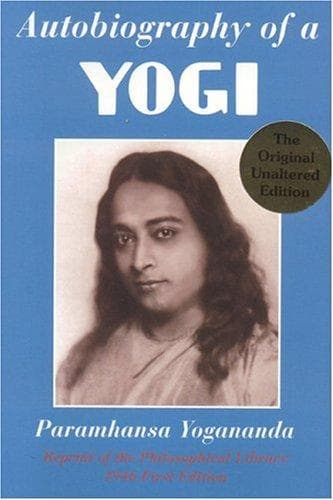
Yogananda, Paramahansa, 1893-1952; Yogis -- India -- Biography
“That is why I opened Santiniketan under the shady trees and
the glories of the sky.” He motioned eloquently to a little group
studying in the beautiful garden. “A child is in his natural setting
amidst the flowers and songbirds. Only thus may he fully express
the hidden wealth of his individual endowment. True education can
never be crammed and pumped from without; rather it must aid in
bringing spontaneously to the surface the infinite hoards of wisdom
within.” {FN29-2}
I agreed. “The idealistic and hero-worshiping instincts of the young
are starved on an exclusive diet of statistics and chronological
eras.”
The poet spoke lovingly of his father, Devendranath, who had inspired
the Santiniketan beginnings.
“Father presented me with this fertile land, where he had already
built a guest house and temple,” Rabindranath told me. “I started
my educational experiment here in 1901, with only ten boys. The
eight thousand pounds which came with the Nobel Prize all went for
the upkeep of the school.”
The elder Tagore, Devendranath, known far and wide as “Maharishi,”
was a very remarkable man, as one may discover from his AUTOBIOGRAPHY.
Two years of his manhood were spent in meditation in the Himalayas. In
turn, his father, Dwarkanath Tagore, had been celebrated throughout
Bengal for his munificent public benefactions. From this illustrious
tree has sprung a family of geniuses. Not Rabindranath alone; all
his relatives have distinguished themselves in creative expression.
His brothers, Gogonendra and Abanindra, are among the foremost artists
{FN29-3} of India; another brother, Dwijendra, is a deep-seeing
philosopher, at whose gentle call the birds and woodland creatures
respond.
Rabindranath invited me to stay overnight in the guest house. It
was indeed a charming spectacle, in the evening, to see the poet
seated with a group in the patio. Time unfolded backward: the scene
before me was like that of an ancient hermitage-the joyous singer
encircled by his devotees, all aureoled in divine love. Tagore
knitted each tie with the cords of harmony. Never assertive, he drew
and captured the heart by an irresistible magnetism. Rare blossom
of poesy blooming in the garden of the Lord, attracting others by
a natural fragrance!
In his melodious voice, Rabindranath read to us a few of his exquisite
poems, newly created. Most of his songs and plays, written for the
delectation of his students, have been composed at Santiniketan.
The beauty of his lines, to me, lies in his art of referring to
God in nearly every stanza, yet seldom mentioning the sacred Name.
“Drunk with the bliss of singing,” he wrote, “I forget myself and
call thee friend who art my lord.”
The following day, after lunch, I bade the poet a reluctant farewell.
I rejoice that his little school has now grown to an international
university, “Viswa-Bharati,” where scholars of all lands have found
an ideal setting.
Public-domain text, read in full here on John Shaqi.
Reviews
Reviews
No reviews yet
Be the first to share your thoughts on this work.
Elsewhere in the archive
Join the Discussion
Join the discussion
Sign in to leave a comment or review.
Sign InorCreate an account