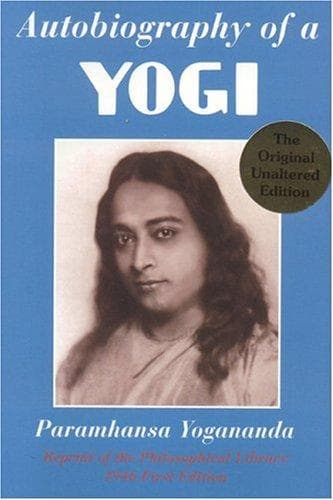
Yogananda, Paramahansa, 1893-1952; Yogis -- India -- Biography
“Babaji’s spiritual state is beyond human comprehension,” Sri
Yukteswar explained to me. “The dwarfed vision of men cannot pierce
to his transcendental star. One attempts in vain even to picture
the avatar’s attainment. It is inconceivable.”
The UPANISHADS have minutely classified every stage of spiritual
advancement. A SIDDHA (“perfected being”) has progressed from the
state of a JIVANMUKTA (“freed while living”) to that of a PARAMUKTA
(“supremely free”-full power over death); the latter has completely
escaped from the mayic thralldom and its reincarnational round. The
PARAMUKTA therefore seldom returns to a physical body; if he does,
he is an avatar, a divinely appointed medium of supernal blessings
on the world.
An avatar is unsubject to the universal economy; his pure body,
visible as a light image, is free from any debt to nature. The
casual gaze may see nothing extraordinary in an avatar’s form but
it casts no shadow nor makes any footprint on the ground. These are
outward symbolic proofs of an inward lack of darkness and material
bondage. Such a God-man alone knows the Truth behind the relativities
of life and death. Omar Khayyam, so grossly misunderstood, sang of
this liberated man in his immortal scripture, the RUBAIYAT:
“Ah, Moon of my Delight who know’st no wane,
The Moon of Heav’n is rising once again;
How oft hereafter rising shall she look
Through this same Garden after me-in vain!”
The “Moon of Delight” is God, eternal Polaris, anachronous never.
The “Moon of Heav’n” is the outward cosmos, fettered to the law of
periodic recurrence. Its chains had been dissolved forever by the
Persian seer through his self-realization. “How oft hereafter rising
shall she look . . . after me-in vain!” What frustration of search
by a frantic universe for an absolute omission!
[Illustration: BABAJI, THE MAHAVATAR, Guru of Lahiri Mahasaya, I have
helped an artist to draw a true likeness of the great Yogi-Christ
of modern India.—see babaji.jpg]
[Illustration: One of the caves occupied by Babaji in the Drongiri
Mountains near Ranikhet in the Himalayas. A grandson of Lahiri
Mahasaya, Ananda Mohan Lahiri (second from right, in white), and
three other devotees are visiting the sacred spot.—see cave.jpg]
Christ expressed his freedom in another way: “And a certain scribe
came, and said unto him, Master, I will follow thee whithersoever
thou goest. And Jesus saith unto him, The foxes have holes, and the
birds of the air have nests; but the Son of man hath not where to
lay his head.” {FN33-1}
Spacious with omnipresence, could Christ indeed be followed except
in the overarching Spirit?
Krishna, Rama, Buddha, and Patanjali were among the ancient Indian
avatars. A considerable poetic literature in Tamil has grown
up around Agastya, a South Indian avatar. He worked many miracles
during the centuries preceding and following the Christian era,
and is credited with retaining his physical form even to this day.
Public-domain text, read in full here on John Shaqi.
Reviews
Reviews
No reviews yet
Be the first to share your thoughts on this work.
Elsewhere in the archive
Join the Discussion
Join the discussion
Sign in to leave a comment or review.
Sign InorCreate an account