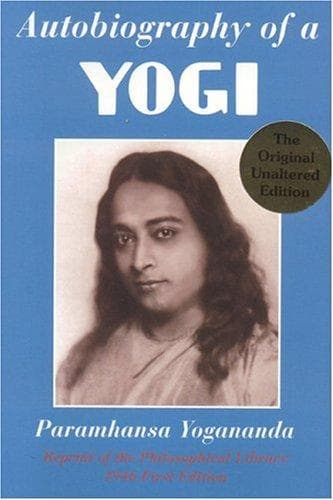
Yogananda, Paramahansa, 1893-1952; Yogis -- India -- Biography
“Welcome!” he scribbled in Hindi; it was a Monday, his weekly day
of silence.
Though this was our first meeting, we beamed on each other
affectionately. In 1925 Mahatma Gandhi had honored the Ranchi school
by a visit, and had inscribed in its guest-book a gracious tribute.
The tiny 100-pound saint radiated physical, mental, and spiritual
health. His soft brown eyes shone with intelligence, sincerity,
and discrimination; this statesman has matched wits and emerged the
victor in a thousand legal, social, and political battles. No other
leader in the world has attained the secure niche in the hearts of
his people that Gandhi occupies for India’s unlettered millions.
Their spontaneous tribute is his famous title-MAHATMA, “great
soul.” {FN44-1} For them alone Gandhi confines his attire to the
widely-cartooned loincloth, symbol of his oneness with the downtrodden
masses who can afford no more.
“The ashram residents are wholly at your disposal; please call on
them for any service.” With characteristic courtesy, the Mahatma
handed me this hastily-written note as Mr. Desai led our party from
the writing room toward the guest house.
Our guide led us through orchards and flowering fields to
a tile-roofed building with latticed windows. A front-yard well,
twenty-five feet across, was used, Mr. Desai said, for watering
stock; near-by stood a revolving cement wheel for threshing rice.
Each of our small bedrooms proved to contain only the irreducible
minimum-a bed, handmade of rope. The whitewashed kitchen boasted a
faucet in one corner and a fire pit for cooking in another. Simple
Arcadian sounds reached our ears-the cries of crows and sparrows,
the lowing of cattle, and the rap of chisels being used to chip
stones.
Observing Mr. Wright’s travel diary, Mr. Desai opened a page and
wrote on it a list of SATYAGRAHA {FN44-2} vows taken by all the
Mahatma’s strict followers (SATYAGRAHIS):
“Nonviolence; Truth; Non-Stealing; Celibacy; Non-Possession;
Body-Labor; Control of the Palate; Fearlessness; Equal Respect for
all Religions; SWADESHI (use of home manufactures); Freedom from
Untouchability. These eleven should be observed as vows in a spirit
of humility.”
(Gandhi himself signed this page on the following day, giving the
date also-August 27, 1935.)
Two hours after our arrival my companions and I were summoned
to lunch. The Mahatma was already seated under the arcade of the
ashram porch, across the courtyard from his study. About twenty-five
barefooted SATYAGRAHIS were squatting before brass cups and plates.
A community chorus of prayer; then a meal served from large brass
pots containing CHAPATIS (whole-wheat unleavened bread) sprinkled
with GHEE; TALSARI (boiled and diced vegetables), and a lemon jam.
Public-domain text, read in full here on John Shaqi.
Reviews
Reviews
No reviews yet
Be the first to share your thoughts on this work.
Elsewhere in the archive
Join the Discussion
Join the discussion
Sign in to leave a comment or review.
Sign InorCreate an account