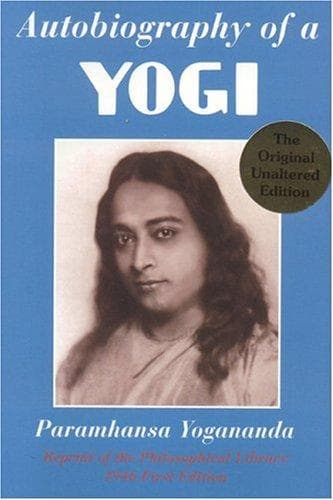
Yogananda, Paramahansa, 1893-1952; Yogis -- India -- Biography
My guru ordinarily was gentle and affable to guests; his welcome was
given with charming cordiality. Yet inveterate egotists sometimes
suffered an invigorating shock. They confronted in Master either
a frigid indifference or a formidable opposition: ice or iron!
A noted chemist once crossed swords with Sri Yukteswar. The
visitor would not admit the existence of God, inasmuch as science
has devised no means of detecting Him.
“So you have inexplicably failed to isolate the Supreme Power in
your test tubes!” Master’s gaze was stern. “I recommend an unheard-of
experiment. Examine your thoughts unremittingly for twenty-four
hours. Then wonder no longer at God’s absence.”
A celebrated pundit received a similar jolt. With ostentatious
zeal, the scholar shook the ashram rafters with scriptural lore.
Resounding passages poured from the MAHABHARATA, the UPANISHADS,
{FN12-21} the BHASYAS {FN12-22} of Shankara.
“I am waiting to hear you.” Sri Yukteswar’s tone was inquiring, as
though utter silence had reigned. The pundit was puzzled.
“Quotations there have been, in superabundance.” Master’s words
convulsed me with mirth, as I squatted in my corner, at a respectful
distance from the visitor. “But what original commentary can you
supply, from the uniqueness of your particular life? What holy
text have you absorbed and made your own? In what ways have these
timeless truths renovated your nature? Are you content to be a
hollow victrola, mechanically repeating the words of other men?”
“I give up!” The scholar’s chagrin was comical. “I have no inner
realization.”
For the first time, perhaps, he understood that discerning placement
of the comma does not atone for a spiritual coma.
“These bloodless pedants smell unduly of the lamp,” my guru remarked
after the departure of the chastened one. “They prefer philosophy
to be a gentle intellectual setting-up exercise. Their elevated
thoughts are carefully unrelated either to the crudity of outward
action or to any scourging inner discipline!”
Master stressed on other occasions the futility of mere book
learning.
“Do not confuse understanding with a larger vocabulary,” he remarked.
“Sacred writings are beneficial in stimulating desire for inward
realization, if one stanza at a time is slowly assimilated. Continual
intellectual study results in vanity and the false satisfaction of
an undigested knowledge.”
Sri Yukteswar related one of his own experiences in scriptural
edification. The scene was a forest hermitage in eastern Bengal,
where he observed the procedure of a renowned teacher, Dabru Ballav.
His method, at once simple and difficult, was common in ancient
India.
Dabru Ballav had gathered his disciples around him in the sylvan
solitudes. The holy BHAGAVAD GITA was open before them. Steadfastly
they looked at one passage for half an hour, then closed their eyes.
Another half hour slipped away. The master gave a brief comment.
Motionless, they meditated again for an hour. Finally the guru
spoke.
Public-domain text, read in full here on John Shaqi.
Reviews
Reviews
No reviews yet
Be the first to share your thoughts on this work.
Elsewhere in the archive
Join the Discussion
Join the discussion
Sign in to leave a comment or review.
Sign InorCreate an account