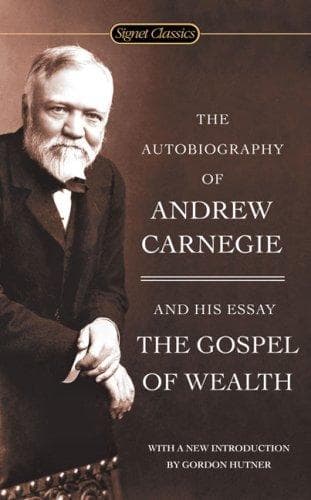
Carnegie, Andrew, 1835-1919; Industrialists -- United States -- Biography; Philanthropists -- United States -- Biography
America is soon to change from being the dearest steel manufacturing
country to the cheapest. Already the shipyards of Belfast are our
customers. This is but the beginning. Under present conditions America
can produce steel as cheaply as any other land, notwithstanding its
higher-priced labor. There is no labor so cheap as the dearest in the
mechanical field, provided it is free, contented, zealous, and reaping
reward as it renders service. And here America leads.
One great advantage which America will have in competing in the
markets of the world is that her manufacturers will have the best home
market. Upon this they can depend for a return upon capital, and the
surplus product can be exported with advantage, even when the prices
received for it do not more than cover actual cost, provided the
exports be charged with their proportion of all expenses. The nation
that has the best home market, especially if products are
standardized, as ours are, can soon outsell the foreign producer. The
phrase I used in Britain in this connection was: "The Law of the
Surplus." It afterward came into general use in commercial
discussions.
CHAPTER XVII
THE HOMESTEAD STRIKE
While upon the subject of our manufacturing interests, I may record
that on July 1, 1892, during my absence in the Highlands of Scotland,
there occurred the one really serious quarrel with our workmen in our
whole history. For twenty-six years I had been actively in charge of
the relations between ourselves and our men, and it was the pride of
my life to think how delightfully satisfactory these had been and
were. I hope I fully deserved what my chief partner, Mr. Phipps, said
in his letter to the "New York Herald," January 30, 1904, in reply to
one who had declared I had remained abroad during the Homestead
strike, instead of flying back to support my partners. It was to the
effect that "I was always disposed to yield to the demands of the men,
however unreasonable"; hence one or two of my partners did not wish me
to return.[42] Taking no account of the reward that comes from
feeling that you and your employees are friends and judging only from
economical results, I believe that higher wages to men who respect
their employers and are happy and contented are a good investment,
yielding, indeed, big dividends.
[Footnote 42: The full statement of Mr. Phipps is as follows:
_Question:_ "It was stated that Mr. Carnegie acted in a cowardly
manner in not returning to America from Scotland and being present
when the strike was in progress at Homestead."
_Answer:_ "When Mr. Carnegie heard of the trouble at Homestead he
immediately wired that he would take the first ship for America, but
his partners begged him not to appear, as they were of the opinion
that the welfare of the Company required that he should not be in this
country at the time. They knew of his extreme disposition to always
grant the demands of labor, however unreasonable.
Public-domain text, read in full here on John Shaqi.
Reviews
Reviews
No reviews yet
Be the first to share your thoughts on this work.
Elsewhere in the archive
Join the Discussion
Join the discussion
Sign in to leave a comment or review.
Sign InorCreate an account