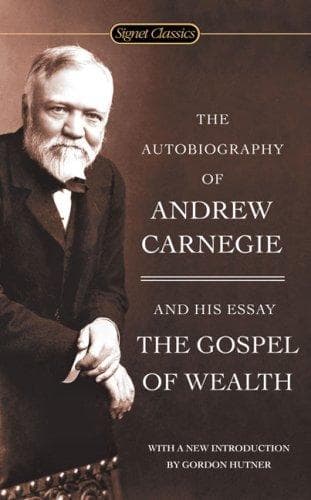
Carnegie, Andrew, 1835-1919; Industrialists -- United States -- Biography; Philanthropists -- United States -- Biography
"I have never known of any one interested in the business to make any
complaint about Mr. Carnegie's absence at that time, but all the
partners rejoiced that they were permitted to manage the affair in
their own way." (Henry Phipps in the _New York Herald_, January 30,
1904.)]
The manufacture of steel was revolutionized by the Bessemer
open-hearth and basic inventions. The machinery hitherto employed had
become obsolete, and our firm, recognizing this, spent several
millions at Homestead reconstructing and enlarging the works. The new
machinery made about sixty per cent more steel than the old. Two
hundred and eighteen tonnage men (that is, men who were paid by the
ton of steel produced) were working under a three years' contract,
part of the last year being with the new machinery. Thus their
earnings had increased almost sixty per cent before the end of the
contract.
The firm offered to divide this sixty per cent with them in the new
scale to be made thereafter. That is to say, the earnings of the men
would have been thirty per cent greater than under the old scale and
the other thirty per cent would have gone to the firm to recompense it
for its outlay. The work of the men would not have been much harder
than it had been hitherto, as the improved machinery did the work.
This was not only fair and liberal, it was generous, and under
ordinary circumstances would have been accepted by the men with
thanks. But the firm was then engaged in making armor for the United
States Government, which we had declined twice to manufacture and
which was urgently needed. It had also the contract to furnish
material for the Chicago Exhibition. Some of the leaders of the men,
knowing these conditions, insisted upon demanding the whole sixty per
cent, thinking the firm would be compelled to give it. The firm could
not agree, nor should it have agreed to such an attempt as this to
take it by the throat and say, "Stand and deliver." It very rightly
declined. Had I been at home nothing would have induced me to yield to
this unfair attempt to extort.
Up to this point all had been right enough. The policy I had pursued
in cases of difference with our men was that of patiently waiting,
reasoning with them, and showing them that their demands were unfair;
but never attempting to employ new men in their places--never. The
superintendent of Homestead, however, was assured by the three
thousand men who were not concerned in the dispute that they could run
the works, and were anxious to rid themselves of the two hundred and
eighteen men who had banded themselves into a union and into which
they had hitherto refused to admit those in other departments--only
the "heaters" and "rollers" of steel being eligible.
Public-domain text, read in full here on John Shaqi.
Reviews
Reviews
No reviews yet
Be the first to share your thoughts on this work.
Elsewhere in the archive
Join the Discussion
Join the discussion
Sign in to leave a comment or review.
Sign InorCreate an account