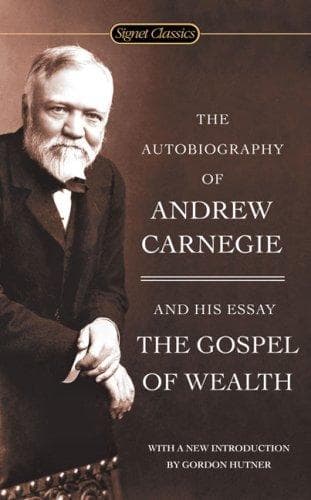
Carnegie, Andrew, 1835-1919; Industrialists -- United States -- Biography; Philanthropists -- United States -- Biography
[Footnote 68: "Mr. Carnegie had proved his originality, fullness of
mind, and bold strength of character, as much or more in the
distribution of wealth as he had shown skill and foresight in its
acquisition. We had become known to one another more than twenty years
before through Matthew Arnold. His extraordinary freshness of spirit
easily carried Arnold, Herbert Spencer, myself, and afterwards many
others, high over an occasional crudity or haste in judgment such as
befalls the best of us in ardent hours. People with a genius for
picking up pins made as much as they liked of this: it was wiser to do
justice to his spacious feel for the great objects of the world--for
knowledge and its spread, invention, light, improvement of social
relations, equal chances to the talents, the passion for peace. These
are glorious things; a touch of exaggeration in expression is easy to
set right.... A man of high and wide and well-earned mark in his
generation." (John, Viscount Morley, in _Recollections_, vol. II, pp.
110, 112. New York, 1919.)]
[Illustration: _Photograph from Underwood & Underwood, N.Y._
VISCOUNT MORLEY OF BLACKBURN]
I told him the story of the pessimist whom nothing ever pleased, and
the optimist whom nothing ever displeased, being congratulated by the
angels upon their having obtained entrance to heaven. The pessimist
replied:
"Yes, very good place, but somehow or other this halo don't fit my
head exactly."
The optimist retorted by telling the story of a man being carried down
to purgatory and the Devil laying his victim up against a bank while
he got a drink at a spring--temperature very high. An old friend
accosted him:
"Well, Jim, how's this? No remedy possible; you're a gone coon sure."
The reply came: "Hush, it might be worse."
"How's that, when you are being carried down to the bottomless pit?"
"Hush"--pointing to his Satanic Majesty--"he might take a notion to
make me carry him."
Morley, like myself, was very fond of music and reveled in the morning
hour during which the organ was being played at Skibo. He was
attracted by the oratorios as also Arthur Balfour. I remember they got
tickets together for an oratorio at the Crystal Palace. Both are sane
but philosophic, and not very far apart as philosophers, I understand;
but some recent productions of Balfour send him far afield
speculatively--a field which Morley never attempts. He keeps his foot
on the firm ground and only treads where the way is cleared. No
danger of his being "lost in the woods" while searching for the path.
Public-domain text, read in full here on John Shaqi.
Reviews
Reviews
No reviews yet
Be the first to share your thoughts on this work.
Elsewhere in the archive
Join the Discussion
Join the discussion
Sign in to leave a comment or review.
Sign InorCreate an account