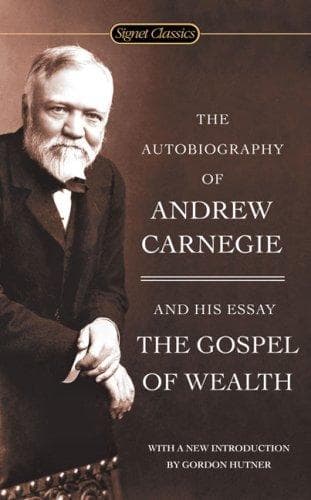
Carnegie, Andrew, 1835-1919; Industrialists -- United States -- Biography; Philanthropists -- United States -- Biography
Morley's most astonishing announcement of recent days was in his
address to the editors of the world, assembled in London. He informed
them in effect that a few lines from Burns had done more to form and
maintain the present improved political and social conditions of the
people than all the millions of editorials ever written. This followed
a remark that there were now and then a few written or spoken words
which were in themselves events; they accomplished what they
described. Tom Paine's "Rights of Man" was mentioned as such.
Upon his arrival at Skibo after this address we talked it over. I
referred to his tribute to Burns and his six lines, and he replied
that he didn't need to tell me what lines these were.
"No," I said, "I know them by heart."
In a subsequent address, unveiling a statue of Burns in the park at
Montrose, I repeated the lines I supposed he referred to, and he
approved them. He and I, strange to say, had received the Freedom of
Montrose together years before, so we are fellow-freemen.
At last I induced Morley to visit us in America, and he made a tour
through a great part of our country in 1904. We tried to have him meet
distinguished men like himself. One day Senator Elihu Root called at
my request and Morley had a long interview with him. After the Senator
left Morley remarked to me that he had enjoyed his companion greatly,
as being the most satisfactory American statesman he had yet met. He
was not mistaken. For sound judgment and wide knowledge of our public
affairs Elihu Root has no superior.
Morley left us to pay a visit to President Roosevelt at the White
House, and spent several fruitful days in company with that
extraordinary man. Later, Morley's remark was:
"Well, I've seen two wonders in America, Roosevelt and Niagara."
That was clever and true to life--a great pair of roaring, tumbling,
dashing and splashing wonders, knowing no rest, but both doing their
appointed work, such as it is.
Morley was the best person to have the Acton library and my gift of it
to him came about in this way. When Mr. Gladstone told me the position
Lord Acton was in, I agreed, at his suggestion, to buy Acton's library
and allow it to remain for his use during life. Unfortunately, he did
not live long to enjoy it--only a few years--and then I had the
library upon my hands. I decided that Morley could make the best use
of it for himself and would certainly leave it eventually to the
proper institution. I began to tell him that I owned it when he
interrupted me, saying:
"Well, I must tell you I have known this from the day you bought it.
Mr. Gladstone couldn't keep the secret, being so overjoyed that Lord
Acton had it secure for life."
Public-domain text, read in full here on John Shaqi.
Reviews
Reviews
No reviews yet
Be the first to share your thoughts on this work.
Elsewhere in the archive
Join the Discussion
Join the discussion
Sign in to leave a comment or review.
Sign InorCreate an account