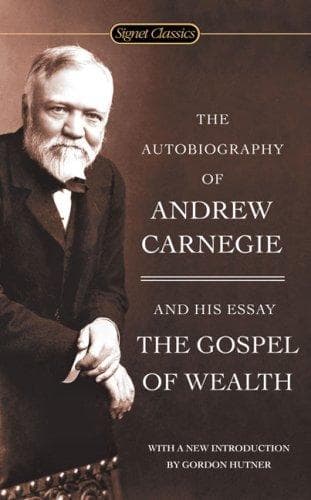
Carnegie, Andrew, 1835-1919; Industrialists -- United States -- Biography; Philanthropists -- United States -- Biography
There spoke the true Morrison, taught to depend on himself, and
independent as Lucifer. Not long afterwards I heard of his promotion
to the superintendency of our newly acquired works at Duquesne, and
from that position he steadily marched upward. He is to-day a
blooming, but still sensible, millionaire. We are all proud of Tom
Morrison. [A note received from him yesterday invites Mrs. Carnegie
and myself to be his guests during our coming visit of a few days at
the annual celebration of the Carnegie Institute.]
I was always advising that our iron works should be extended and new
developments made in connection with the manufacture of iron and
steel, which I saw was only in its infancy. All apprehension of its
future development was dispelled by the action of America with regard
to the tariff upon foreign imports. It was clear to my mind that the
Civil War had resulted in a fixed determination upon the part of the
American people to build a nation within itself, independent of Europe
in all things essential to its safety. America had been obliged to
import all her steel of every form and most of the iron needed,
Britain being the chief seller. The people demanded a home supply and
Congress granted the manufacturers a tariff of twenty-eight per cent
_ad valorem_ on steel rails--the tariff then being equal to about
twenty-eight dollars per ton. Rails were selling at about a hundred
dollars per ton, and other rates in proportion.
Protection has played a great part in the development of manufacturing
in the United States. Previous to the Civil War it was a party
question, the South standing for free trade and regarding a tariff as
favorable only to the North. The sympathy shown by the British
Government for the Confederacy, culminating in the escape of the
Alabama and other privateers to prey upon American commerce, aroused
hostility against that Government, notwithstanding the majority of her
common people favored the United States. The tariff became no longer a
party question, but a national policy, approved by both parties. It
had become a patriotic duty to develop vital resources. No less than
ninety Northern Democrats in Congress, including the Speaker of the
House, agreed upon that point.
Capital no longer hesitated to embark in manufacturing, confident as
it was that the nation would protect it as long as necessary. Years
after the war, demands for a reduction of the tariff arose and it was
my lot to be drawn into the controversy. It was often charged that
bribery of Congressmen by manufacturers was common. So far as I know
there was no foundation for this. Certainly the manufacturers never
raised any sums beyond those needed to maintain the Iron and Steel
Association, a matter of a few thousand dollars per year. They did,
however, subscribe freely to a campaign when the issue was Protection
_versus_ Free Trade.
Public-domain text, read in full here on John Shaqi.
Reviews
Reviews
No reviews yet
Be the first to share your thoughts on this work.
Elsewhere in the archive
Join the Discussion
Join the discussion
Sign in to leave a comment or review.
Sign InorCreate an account