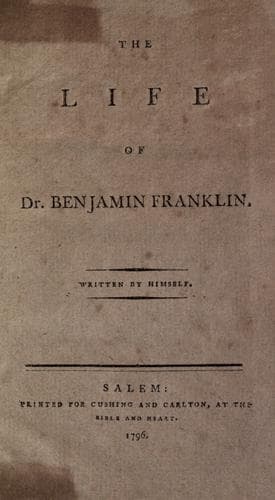
Autobiography of Benjamin FranklinFranklin, Benjamin
History
Autobiography of Benjamin Franklin
Franklin, Benjamin
Franklin, Benjamin, 1706-1790; Statesmen -- United States -- Biography
In order to march thither, I assembled the companies at Bethlehem, the
chief establishment of those people. I was surprised to find it in so
good a posture of defense; the destruction of Gnadenhut had made them
apprehend danger. The principal buildings were defended by a stockade;
they had purchased a quantity of arms and ammunition from New York,
and had even plac'd quantities of small paving stones between the
windows of their high stone houses, for their women to throw down upon
the heads of any Indians that should attempt to force into them. The
armed brethren, too, kept watch, and reliev'd as methodically as in
any garrison town. In conversation with the bishop, Spangenberg, I
mention'd this my surprise; for, knowing they had obtained an act of
Parliament exempting them from military duties in the colonies, I had
suppos'd they were conscientiously scrupulous of bearing arms. He
answer'd me that it was not one of their established principles, but
that, at the time of their obtaining that act, it was thought to be a
principle with many of their people. On this occasion, however, they,
to their surprise, found it adopted by but a few. It seems they were
either deceiv'd in themselves, or deceiv'd the Parliament; but common
sense, aided by present danger, will sometimes be too strong for
whimsical opinions.
It was the beginning of January when we set out upon this business of
building forts. I sent one detachment toward the Minisink, with
instructions to erect one for the security of that upper part of the
country, and another to the lower part, with similar instructions; and
I concluded to go myself with the rest of my force to Gnadenhut, where
a fort was tho't more immediately necessary. The Moravians procur'd me
five waggons for our tools, stores, baggage, etc.
Just before we left Bethlehem, eleven farmers, who had been driven
from their plantations by the Indians, came to me requesting a supply
of firearms, that they might go back and fetch off their cattle. I
gave them each a gun with suitable ammunition. We had not march'd many
miles before it began to rain, and it continued raining all day; there
were no habitations on the road to shelter us, till we arriv'd near
night at the house of a German, where, and in his barn, we were all
huddled together, as wet as water could make us. It was well we were
not attack'd in our march, for our arms were of the most ordinary
sort, and our men could not keep their gun locks[104] dry. The Indians
are dexterous in contrivances for that purpose, which we had not. They
met that day the eleven poor farmers above mentioned, and killed ten
of them. The one who escap'd inform'd that his and his companions'
guns would not go off, the priming being wet with the rain.
[104] Flint-lock guns, discharged by means of a spark
struck from flint and steel into powder (priming) in an
open pan.
[Illustration: "We had not march'd many miles before it began to rain"]
Public-domain text, read in full here on John Shaqi.
Reviews
Reviews
No reviews yet
Be the first to share your thoughts on this work.
Elsewhere in the archive
Join the Discussion
Join the discussion
Sign in to leave a comment or review.
Sign InorCreate an account