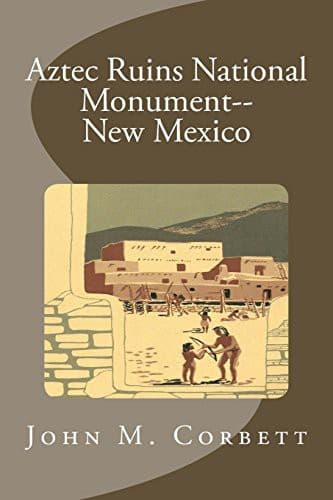
Aztec Ruins National Monument, New MexicoCorbett, John M. (John Maxwell)
History
Aztec Ruins National Monument, New Mexico
Corbett, John M. (John Maxwell)
Aztec Ruins National Monument (N.M.)
Unfortunately, the Animas is one of the river valleys in the San Juan
drainage which has not been particularly well surveyed or investigated
archeologically. Accounts by early settlers, and passing references in
some of Morris’ reports, indicate that in aboriginal times (certainly
during Pueblo times), the valley was no doubt heavily populated. It
should have been. Good water is readily available in the river and the
climate is healthful; prehistorically, game must have abounded in the
nearby foothills and mountains. Settlement and clearing of lands in more
recent times have eliminated many of the prehistoric remains, but the
higher banks along the river terraces still show low mounds of rubble,
obviously man made, with indications of cobble and sandstone walls,
which evidently were dwellings of the Pueblo Period.
Best known in this valley area are the cave and open sites that Morris
excavated north of Durango and which contained the remains of early
Basketmaker peoples already mentioned and the great pueblo of Aztec,
near the town of the same name about 15 miles above the confluence of
the Animas and San Juan Rivers. As described elsewhere, this latter
structure was also excavated by Morris in 1916-21. Without doubt, parts
of the valley were more or less continuously occupied from early
Basketmaker times until the final abandonment of the Four Corners
country about A.D. 1300. Although we have no firm data on which to base
conclusions, it would be safe to assume that the Developmental Pueblo
Period in the Animas Valley lasted from about A.D. 750 or 800 to 1050 or
1100, and that conditions in the living patterns of the people elsewhere
were reflected in the Animas Valley.
As the Developmental Pueblo Period progressed, house arrangements became
more complex. The next step seems to have been an extension of the
earlier linear or crescent-shaped alinement of contiguous houses by
adding on one or more wings, so that the resulting plan was L-shaped or
formed a rectangular U. In these cases, the semisubterranean kiva was
still retained in the courtyard as a definite religious structure. These
types of planned communities are called “unit houses.” Most were single
storied, though some may have had a second story added on the back tier
of rooms.
Public-domain text, read in full here on John Shaqi.
Reviews
Reviews
No reviews yet
Be the first to share your thoughts on this work.
Join the Discussion
Join the discussion
Sign in to leave a comment or review.
Sign InorCreate an account