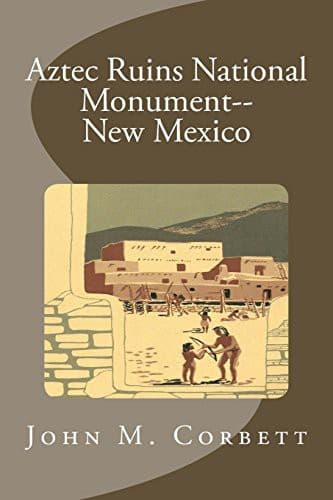
Aztec Ruins National Monument, New Mexico — John Shaqi
Aztec Ruins National Monument, New MexicoCorbett, John M. (John Maxwell)
History
Aztec Ruins National Monument, New Mexico
Corbett, John M. (John Maxwell)
Aztec Ruins National Monument (N.M.)
In the field of minor arts and ornaments, the people of this period
reached a high degree of achievement. _Olivella_ shell beads were still
widely used as well as stone beads and stone and shell pendants carved
in the forms of birds and animals. Turquoise, which first seems to have
been used in late Basketmaker times, was used extensively for some of
the finest ornaments, not only for beads and pendants but also in
beautiful mosaics.
[Illustration: Chaco-style pottery bowl. Maximum diameter, 9″; Height,
4¼″.]
However, it is the large multistoried pueblos of the Chaco Canyon and
the great cliff dwellings of the Mesa Verde that attract the most
attention. The native sandstone at Chaco Canyon made an excellent
building material—it was easily obtainable, it fractured along natural
cleavage planes into thin slabs, and it could be ground and pecked into
large rectangular blocks. Both the availability of sandstone and the
relative ease with which it could be worked were important factors in
developing the Chaco style of architecture.
Some of these pueblos may have been as high as five stories; most were
at least three or four stories. All show signs of constant alteration in
individual rooms and in their general layout, as though some feverish
urge was forcing the people to keep shifting the arrangement of their
dwellings. Not all the rooms in any of the large pueblos were occupied
simultaneously; usually the rooms toward the rear were used for storage
or, in many cases, as dumps for refuse and garbage. Occasionally,
burials are found in them.
All the great Chaco pueblos form self-contained units—that is, they were
built around central plazas or courtyards, as in the case of Pueblo
Bonito, with a low row of single-storied rooms closing off the formerly
open side of the plaza, or they were roughly rectangular with closely
knit contiguous rooms and internal kivas as in Yellow House. This
closure, plus the fact that the doors and windows which formerly had
opened outward at the rear or sides are now sealed up, has led many
people to believe the later parts of this period were marked by trouble
and strife and that this self-containment was a defensive measure.
Public-domain text, read in full here on John Shaqi.
Reviews
Reviews
No reviews yet
Be the first to share your thoughts on this work.
Join the Discussion
Join the discussion
Sign in to leave a comment or review.
Sign InorCreate an account