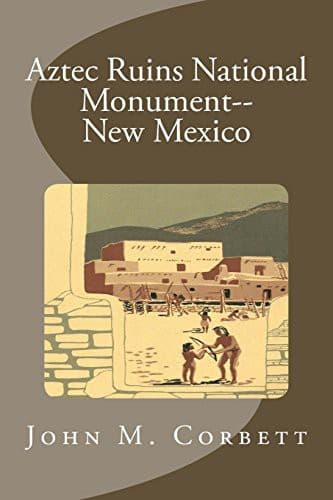
Aztec Ruins National Monument, New MexicoCorbett, John M. (John Maxwell)
History
Aztec Ruins National Monument, New Mexico
Corbett, John M. (John Maxwell)
Aztec Ruins National Monument (N.M.)
Aztec, at the height of the Chacoan occupation, must have been a
fascinating sight. On a sunny summer day, the plaza and rooftops would
have been a busy swarm of activity—mothers nursing and tending their
young, grinding corn for tortillas, preparing meat for the stew pot,
making baskets, and molding clay pots for later firing. Old men basked
in the sun or instructed the young boys. Most of the men and older boys
were busy tending the corn, beans, and squash in the fertile fields
surrounding the pueblo. This was exacting work, since each plot, clan by
clan, had to receive its carefully husbanded share of water from the
irrigation ditch that ran along the slope of the high terrace just to
the north of the pueblo. At times during the day, hunters would straggle
in happily if burdened with game, sadly and slowly if empty-handed after
a fruitless chase. Occasionally a wandering group of strangers would
pass by with items to trade. They were made welcome and fed, and the
whole plaza took on a festive air.
At night the pueblo must have presented a vastly different appearance:
dark, mysterious, and quiet. Here and there a small dying fire cast a
flickering glow upon a brown adobe wall. In one or two of the kivas, a
faint light through the hatchway in the roof indicated preparations
under way for a ceremony, or perhaps a special highly secret meeting of
one of the clan societies. If you looked closely you might make out one
of the sentinels, silhouetted briefly against the night sky as he
shifted position. But the pueblo was silent—a silence only broken by an
occasional dog’s bark or baby’s wail—until, shortly after the morning
star appeared, the hunters crept quietly out of the pueblo, and as the
star faded, the broadening morning light heralded the approach of
another day in the life of Aztec pueblo.
But something happened. For no reason we can ascertain today, the pueblo
was abandoned by its first occupants. Presumably, this was a fairly fast
exodus, but one in which the people had time to take most of their
treasured possessions with them. There is no evidence that they were
driven away by invaders, or by any other major catastrophe such as fire,
flood, or pestilence. We do not know if they left en masse or perhaps
more gradually, as they arrived, in clans and groups. If a few hardy
souls stayed behind, or if a few weak stragglers couldn’t make the trip,
there is no evidence. All we know is that by about A.D. 1125, or perhaps
1130, the pueblo was empty. For almost a hundred years the great
structure stood alone, untended and uninhabited. Perhaps the local
people occasionally used a loosening beam from the structure, or
gathered up a few blocks from the slowly crumbling walls, or helped
themselves to any readily useful articles left behind, but otherwise
they and any passing wanderers seem to have left the place alone.
Public-domain text, read in full here on John Shaqi.
Reviews
Reviews
No reviews yet
Be the first to share your thoughts on this work.
Join the Discussion
Join the discussion
Sign in to leave a comment or review.
Sign InorCreate an account